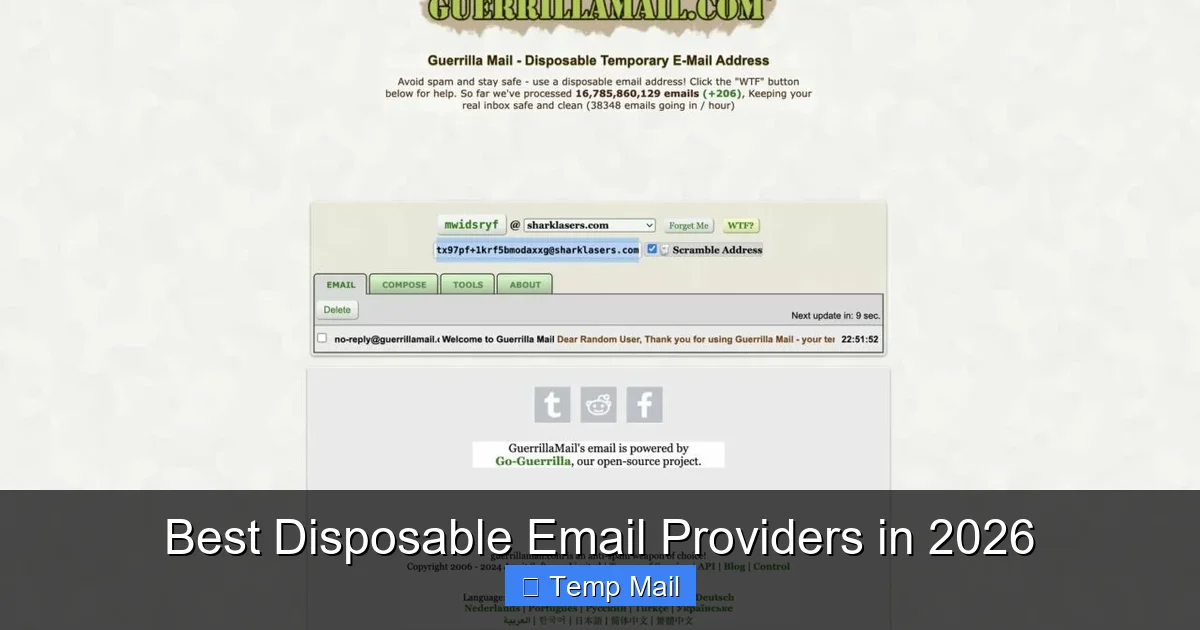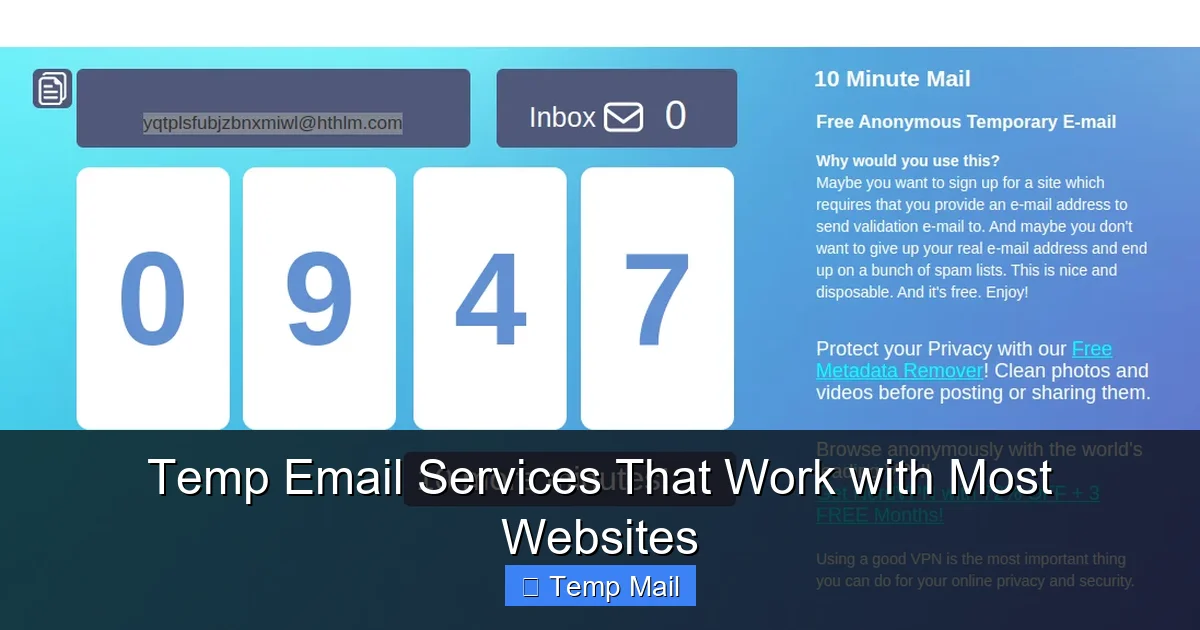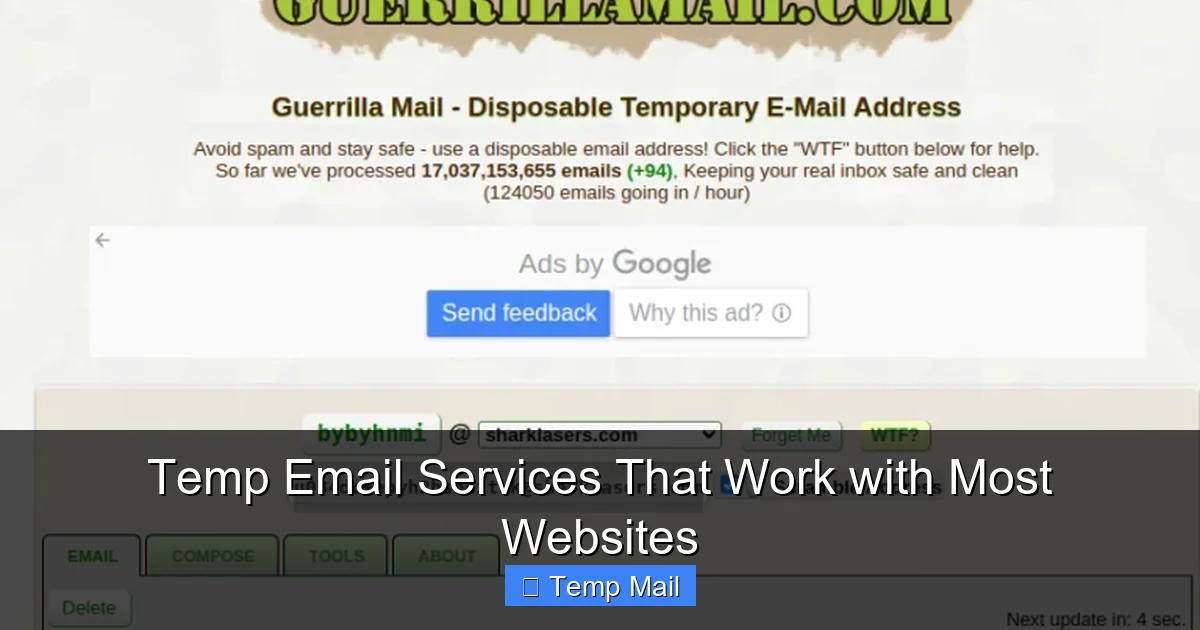
Category: Temp Mail

  • How Temp Mail Protects Your Inbox

    How Temp Mail Protects Your Inbox

    Your main email address is a magnet for spam, data breaches, and unwanted tracking. Temp mail services provide a disposable, anonymous email address you can use for sign-ups, downloads, and any online activity where you don’t want to expose your real contact info. By acting as a protective buffer, these services keep your primary inbox clean, secure, and under your control, dramatically reducing phishing risks and digital clutter.

    Imagine your primary email inbox as your home. You wouldn’t give your front door key to every random person you meet on the street, every store clerk, or every website that asks for it. Yet, that’s exactly what we do every day online. We hand over our most valuable digital key—our email address—to countless websites, apps, and services, often for a simple download or a one-time trial. The result? An inbox flooded with promotions, phishing attempts, and newsletters we never wanted. This is where temporary email services, or temp mail, become your digital bouncer, your privacy shield, and your inbox’s best friend.

    But how does this simple concept actually work to protect your inbox? It’s more than just a random string of characters. It’s a deliberate strategy to reclaim control over your digital footprint. In this guide, we’ll break down the mechanics, the real-world benefits, and the smart ways to use temp mail to transform your online experience from a spam-ridden nightmare into a streamlined, secure sanctuary.

    Key Takeaways

    • Temp mail creates a protective shield: It provides a temporary, disposable email address that you use instead of your primary, permanent email, keeping the latter completely private.
    • It stops spam at the source: By using a temp address for forums, downloads, or one-off services, any resulting spam goes to the disposable inbox, which you simply delete, leaving your main inbox pristine.
    • It mitigates data breach damage: If a website using your temp address suffers a breach, hackers only get access to that temporary, now-invalid address, not your real identity.
    • It enhances privacy and anonymity: No personal information is required to generate most temp emails, allowing you to browse and sign up without linking activities to your true identity.
    • It simplifies account management: For services you try once or rarely use, a temp email means no long-term password to remember and no account to eventually delete manually.
    • Awareness of limitations is key: Temp mail is not for critical accounts (banking, primary social media) as the inbox is temporary and emails are not encrypted for sensitive data.
    • Use it as a strategic tool, not a catch-all: The best practice is to reserve your permanent email for trusted, essential communications and use temp mail for everything else.

    [FEATURED_IMAGE_PLACEHOLDER]

    The Inbox Pollution Problem: Why Your Primary Email is Under Attack

    Before we dive into the solution, let’s fully understand the problem. Your primary email address is a goldmine for marketers and a target for cybercriminals. It’s the unique identifier that ties together your online identity.

    The Spam Engine: How Your Email Gets Sold and Resold

    You sign up for a free e-book from a seemingly reputable site. In the fine print, you may have agreed to their terms, which often include sharing your data with “partners.” That partner then sells your email to an advertiser. That advertiser’s list gets merged with another, and another. Within weeks, your inbox is a wasteland of “special offers” for products you’ve never shown interest in. This isn’t just annoying; it’s a productivity killer. Sifting through spam to find an important email from your boss or family wastes time and mental energy.

    The Phishing and Breach Avalanche

    More sinister is the security risk. Data breaches are daily news. When a company you have an account with gets hacked, your email address is often the first piece of data stolen. Cybercriminals use it to launch targeted phishing attacks, crafting emails that look legitimate to trick you into clicking malicious links or giving up passwords for *other* accounts. If you used your primary email for a low-security forum that was breached, that hacker now has a key to your digital kingdom. They can use it to reset passwords on your bank or social media accounts if those sites rely on email for recovery.

    The Unwanted Tracking Footprint

    Every account you create with your real email adds another data point to your profile. Ad networks and data brokers can associate your browsing habits, interests, and location with that email address, building a detailed profile used to hyper-target you with ads. Even if you trust the company, their security practices might be lax, leaving your data exposed.

    So, your primary inbox is constantly under siege. The solution isn’t to stop using the internet; it’s to stop using your primary email as the universal key.

    What is Temp Mail? The Mechanics of Disposable Email

    Temporary mail is a service that provides you with a random, anonymous email address for a short period—usually 10 minutes to a few hours, sometimes up to a day. You don’t need to register, provide a password, or give any personal information to use it.
    How Temp Mail Protects Your Inbox

    Visual guide about How Temp Mail Protects Your Inbox

    Image source: temp-inbox.me

    How It Works: A Step-by-Step Breakdown

    1. Generation: You visit a temp mail website (like Temp-Mail.org, 10MinuteMail.com, or others). The site instantly generates a random email address for you (e.g., [email protected]) and displays it prominently on the page.
    2. Use: You copy that address and paste it into any website or form that requires an email. You sign up, download the file, or verify the account.
    3. Reception: Any email sent to that disposable address appears in a web-based inbox displayed on the temp mail site. You can view it, sometimes download attachments, and click links *while the inbox is active*.
    4. Destruction: After the time limit expires, or if you manually delete the inbox, the email address and all its messages are permanently wiped from the service’s servers. That address is then recycled and given to another user in the future.

    The Architecture of Anonymity

    The magic lies in the separation. There is no link between the temporary email address and your identity. The service provider doesn’t know who you are. The website you signed up with only knows the disposable address. This breaks the chain of traceability. When that disposable address dies, the connection to that website dies with it. Your primary email, with all its history and associated accounts, remains completely untouched and unknown to that service.

    Primary Protection: How Temp Mail Defends Your Inbox

    Now, let’s connect the mechanics directly to the protection of your main inbox.
    How Temp Mail Protects Your Inbox

    Visual guide about How Temp Mail Protects Your Inbox

    Image source: temp-inbox.me

    Barrier #1: Absolute Spam Containment

    This is the most immediate and satisfying benefit. Let’s say you want to download a wallpaper pack from a sketchy-looking site. You use your temp mail. The site sends a confirmation link and, inevitably, starts sending you “deals” every day. Where do those emails go? To the temp inbox. You simply close the browser tab or wait 10 minutes. The spam never touches your primary inbox. It’s contained and then vaporized. Over time, this single action prevents thousands of unwanted emails from ever being delivered to your important accounts.

    Barrier #2: Phishing and Breach Immunization

    Consider a data breach at a gaming forum you visited once. Hackers steal the user database. What do they get? A list of usernames and—you guessed it—temporary email addresses. Those addresses are either already expired or will expire soon. They are useless for targeted attacks against your real identity. The hacker cannot use that forum email to request a password reset on your Gmail or bank account because the reset link would go to an inbox that no longer exists. Your primary email remains a secret, insulated from the breach.

    Barrier #3: Preventing Unwanted Marketing Profiles

    When you use a temp address for a newsletter you’re semi-interested in or a store you might shop at once, you prevent that company from adding your primary email to its marketing database. You can still read the newsletter or get the discount code via the temp inbox, but your permanent identity isn’t logged in their CRM system. You are a ghost user, consuming content without becoming a marketable asset.

    Practical Use Cases: When and Where to Use Temp Mail

    Knowing *why* it works is one thing. Knowing *when* to use it is the key to unlocking its full potential. Think of temp mail as your default setting for any non-essential online interaction.
    How Temp Mail Protects Your Inbox

    Visual guide about How Temp Mail Protects Your Inbox

    Image source: is1-ssl.mzstatic.com

    For Downloads and “Free Gifts”

    This is the #1 use case. Any time a website asks for your email in exchange for a PDF, template, software trial, or wallpaper pack, use a temp address. You get the file via the temporary inbox, and the obligation (and future spam) vanishes with the inbox.

    For Forum and Comment Section Sign-Ups

    Do you need to create an account just to comment on an article or post in a forum? Use temp mail. You verify the account, make your comment, and never look back. The forum cannot spam you, and if the forum is later compromised, your temp address is the only thing exposed.

    For One-Time Service Trials

    Signing up for a 7-day trial of a SaaS tool? Use a temp email. You’ll get the initial access link and maybe a reminder or two in the temp inbox. When the trial ends, there’s no persistent account tied to your real email to accidentally charge you or clog your inbox with “come back” offers.

    For Accessing Gated Content

    Many blogs and news sites now require an email address to read a certain number of articles. A temp address lets you bypass this paywall-like tactic without subscribing to their newsletter stream.

    For Testing and Development

    Developers and testers use temp mail constantly to create multiple test accounts for apps and websites without managing hundreds of real email accounts. It’s a huge time-saver.

    For Privacy-Conscious Browsing

    Simply visiting a site can sometimes trigger a pop-up asking for your email for “updates.” If you’re not ready to commit, a temp address lets you close that pop-up and continue browsing without pressure or future consequence.

    Security and Privacy: The Deeper Benefits

    Beyond a clean inbox, temp mail offers a layer of digital hygiene that is hard to achieve otherwise.

    Reducing Your Digital Attack Surface

    In cybersecurity, your “attack surface” is all the points where a hacker could potentially gain access. Every account linked to your primary email is a point in that surface. By minimizing the number of sites that have your real email, you drastically reduce the number of places that, if breached, could lead to a credential-stuffing attack on your more important accounts. Temp mail is a form of “security through compartmentalization.”

    Bypassing Unnecessary Data Collection

    Many sites ask for an email not because they need to communicate with you, but because they want a unique user identifier to build a profile. Using a temp email is a quiet act of resistance against this pervasive data economy. You’re saying, “I will consume your content or service, but I will not become your product.”

    Your email address is the most powerful tracking cookie. When combined with browsing data, it creates a terrifyingly complete picture. Temp mail severs this link at the most fundamental level. The activity associated with the temp address cannot be cross-referenced with the activity on your real accounts.

    Limitations and Crucial Best Practices

    Temp mail is a powerful tool, but it’s not a magic bullet. Using it incorrectly can create new problems. Understanding its limits is as important as knowing its strengths.

    What Temp Mail is NOT For

    • Critical Accounts: Never use it for your bank, primary cloud storage (Google Drive, iCloud), main social media accounts (Facebook, Twitter, LinkedIn), or work/school logins. You need permanent, recoverable access to these.
    • Account Recovery: If you use a temp email for an account and then lose access to that temp inbox (which is certain), you will be locked out of that account forever. There is no “forgot password” option.
    • Sending Sensitive Information: Temp inboxes are not encrypted. Do not use them to receive passwords, financial statements, or private documents.
    • Long-Term Subscriptions: If you genuinely want to receive a monthly newsletter from a trusted source, use your primary or a secondary *permanent* email address, not a temp one.

    The Smart User’s Checklist

    To use temp mail effectively and safely, follow this simple protocol:

    1. Have a dedicated primary email. This is for family, close friends, work, and essential services (Amazon, Netflix, your bank). Guard it fiercely.
    2. Consider a secondary permanent email. For less critical but recurring things (like a loyalty program or a hobby newsletter), create a free secondary account with a provider like Gmail or ProtonMail. Use this as your “semi-clean” inbox.
    3. Reserve temp mail for the disposable world. Anything where you want a one-time interaction, a file, or a verification code and have zero intention of maintaining a long-term relationship with the sender.
    4. Check the temp inbox immediately. If you need a verification link, you have a short window. Open the temp mail site in a separate tab while you sign up elsewhere.
    5. Don’t get attached. The moment you finish your task, you can forget about that email address. No need to bookmark it.

    The Future of Inbox Management and Privacy

    The rise of temp mail is a direct response to the broken email ecosystem. It’s a user-powered correction to a system that treats email addresses as public commodities. We are seeing this philosophy expand. Some password managers now include alias generation (like Apple’s “Hide My Email” or Firefox’s “Relay”), which creates unique, forwardable email aliases that are more persistent than temp mail but still protect your real address. This is the evolution: moving from a single, vulnerable primary address to a dynamic, layered identity strategy where your real email is the crown jewel, hidden behind layers of disposable or alias shields.

    As data privacy regulations tighten and user awareness grows, the expectation of an email address as a free-for-all will hopefully diminish. Until then, temp mail remains one of the simplest, most effective tools in your privacy toolkit. It’s a low-effort, high-reward habit that, once adopted, makes you wonder how you ever tolerated a spam-filled inbox before.

    Conclusion: Reclaim Your Digital Peace

    Your inbox doesn’t have to be a war zone. The constant barrage of spam, the lurking fear of a data breach, the feeling of being tracked—these are not inevitable prices of the internet. They are symptoms of using a fragile, permanent tool (your primary email) for every temporary, disposable task the web throws at you.

    Temporary email services offer a profound shift in perspective. They allow you to separate the essential from the expendable in your digital life. By using a disposable address for the 90% of online interactions that are fleeting, you protect the 10% that truly matter. You keep your primary inbox clean, your security intact, and your personal data out of the hands of data brokers.

    Start today. The next time a website asks for your email for a free guide or a quick sign-up, pause. Open a new tab, generate a temp address, and use that instead. Experience the quiet satisfaction of closing that tab knowing your real inbox is safe. That small act is a declaration of digital autonomy. It’s you, taking back control, one disposable address at a time.

    Frequently Asked Questions

    Is using temporary mail legal and safe?

    Yes, using temp mail is completely legal. It is safe for the user as it protects your real identity and inbox from spam and potential breaches. The safety concern is minimal since you are not sending sensitive data through it. The primary risk is to the service provider if the temp address is used for illegal activities, but the user’s anonymity is generally protected.

    Can I recover emails from a temporary inbox later?

    No. The core principle of temp mail is disposability. Once the inbox expires (usually after 10 minutes to a few hours) or you manually clear it, all emails and the address itself are permanently deleted from the server. There is no recovery option, which is why you must only use it for non-critical, one-time purposes.

    Will websites block or ban me for using a temp email?

    Some websites, especially those with strong anti-fraud measures or high-value sign-ups (like certain financial services), may detect and block known temp mail domains. For most general websites, forums, and download portals, it works perfectly. If a site rejects your temp address, you’ll need to use a real one or a secondary permanent email.

    What happens if a website I signed up with using temp mail sends a crucial update?

    You will not receive it. Since the temp mail inbox is gone, the email will bounce back to the sender. This is why you must never use a disposable address for any service where you need ongoing communication, such as account security alerts, subscription confirmations, or official receipts.

    Are temporary email services truly anonymous?

    For the user, yes, they provide a high degree of anonymity. You do not log in, so the service provider has no inherent link between you and the temporary address. However, your IP address is logged by the temp mail site itself, as with any web visit. For extreme anonymity, using a VPN in conjunction with temp mail is recommended.

    How long do temporary email addresses typically last?

    It varies by service. Common durations are 10 minutes, 1 hour, or 1 day. Some services allow you to extend the time manually. The lifespan is always clearly displayed. You must complete your task (like clicking a verification link) within that window.
  • Top Anonymous Email Services Online

    Top Anonymous Email Services Online

    Protecting your digital identity starts with your inbox. Anonymous email services shield your personal information from spam, tracking, and unwanted surveillance. They fall into two main categories: temporary “disposable” emails for quick, one-time sign-ups and fully encrypted, secure providers for long-term, confidential correspondence. Choosing the right tool depends entirely on your specific privacy need—whether it’s avoiding spam or safeguarding sensitive communications from prying eyes.

    Ever felt that slight unease when a random website asks for your email address? You know it’s the gateway to a potential tsunami of spam, targeted ads, and who-knows-what-else. That little “@” symbol has become a digital fingerprint. But what if you could hand out a throwaway address, a secret alias, or a truly locked-down inbox that even the service provider can’t peer into? Welcome to the world of anonymous email services. This isn’t about shady dealings; it’s about reclaiming your digital autonomy. Whether you’re a journalist protecting a source, an activist organizing safely, a shopper tired of promotional clutter, or just someone who values their privacy, there’s an anonymous email tool for you. Let’s break down the landscape, compare the top players, and figure out exactly how to choose and use these powerful privacy shields.

    Key Takeaways

    • Two Core Types: Anonymous email services are primarily either temporary/disposable (for short-term, spam-blocking use) or secure/encrypted (for long-term, private communication).
    • Encryption is Key: True privacy requires end-to-end encryption (E2EE), where only you and the recipient can read the messages, not the service provider.
    • No Perfect Anonymity: Most services still require some sign-up information, and your IP address can be logged unless you use additional tools like a VPN or Tor.
    • Trade-Offs Exist: Disposable emails offer instant, no-registration convenience but lack security and permanence. Secure emails provide robust privacy but often require more setup and may have storage limits.
    • Legal and Acceptable Use: These services are legal tools for privacy protection. Using them for fraud, harassment, or illegal activities violates their Terms of Service and the law.
    • Your Behavior Matters: No service can protect you if you use your real name, share personal details in the email body, or log in from an identifiable network without protection.
    • Combine Tools for Max Privacy: For high-stakes anonymity, pair an anonymous email with a reputable VPN, the Tor Browser, and practice operational security (OPSEC) in your communications.

    What Exactly Are “Anonymous” Email Services?

    Before we dive into the “top” lists, we need to clear up a common misconception. The term “anonymous email” covers a spectrum. At one end, you have services that don’t ask for any personally identifiable information (PII) during sign-up. At the other, you have services that employ military-grade encryption to make the content of your emails unreadable to anyone but the intended recipient. True, complete anonymity—where your identity is untraceable to the act of sending an email—is incredibly difficult to achieve and often requires layering multiple tools. However, the services we’ll discuss provide significant layers of protection that far exceed what Gmail, Outlook, or Yahoo offer by default.

    The Privacy Promise vs. The Reality

    Standard email providers scan your messages to serve ads, build profiles, and comply with government data requests. Anonymous services promise to stop that. Their business models differ: some are funded by premium subscriptions, some by donations, and some (especially disposable ones) by showing non-tracking ads or limiting free features. The core promise is a reduced digital footprint. They minimize the data they collect, often don’t log IP addresses, and use encryption to protect your data in transit and at rest. But a critical rule applies: the service can only protect what it controls. If you reveal your name in the email body or send it to someone who then forwards it from a non-secure account, that protection vanishes.

    Why Would You Need This?

    The use cases are vast and often mundane. You might use a disposable address to download a whitepaper from a company you don’t trust not to sell your contact info. A whistleblower or journalist might use a secure, encrypted service to communicate with a confidential source. Someone living under an oppressive regime might need an email that won’t lead authorities back to their real identity. Everyday users employ these to create accounts on forums they don’t want associated with their primary identity, to sign up for one-time discounts, or to simply avoid the relentless marketing machine. It’s a fundamental tool for digital hygiene and personal security.

    Two Main Categories: Disposable vs. Secure Email

    This is the most crucial distinction. Confusing the two leads to choosing the wrong tool for the job and a false sense of security. Think of it like this: a disposable email is a public payphone—anyone can use it, it’s great for a quick, anonymous call, and you walk away with no trace. A secure email is your own private, soundproofed room with a locked door—it requires a key, it’s for ongoing, confidential conversations, and you control who gets in.

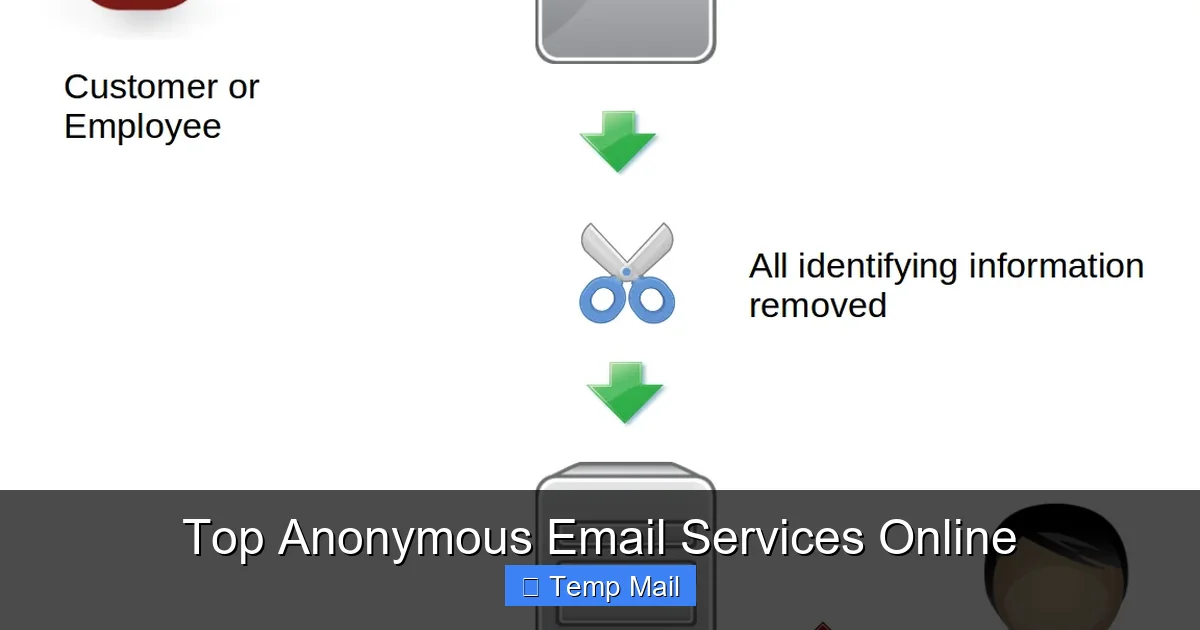
    Top Anonymous Email Services Online

    Visual guide about Top Anonymous Email Services Online

    Image source: sp-ao.shortpixel.ai

    1. Disposable/Temporary Email Services

    These are the classic “temp mail” services. Their defining feature is instant, no-registration access.

    • How they work: You visit the website, they generate a random email address for you (e.g., [email protected]), and you use it immediately. Incoming emails appear in a public inbox on the site. After a set time—usually 10 minutes to a few hours—the address and all its emails are permanently deleted.
    • Primary Use Case: Spam prevention and one-time account activation. Perfect for signing up to a sketchy forum, downloading a file that requires an email, or accessing a gated article you’ll never visit again.
    • Key Limitations: No security. The inbox is publicly accessible to anyone who has the address. There is no encryption between you and the service’s server. Anyone with the URL can read your emails. They are also not for sending emails from; you can only receive. They are a receipt, not a conversation tool.

    2. Secure/Encrypted Email Services

    These are full-featured email providers built from the ground up for privacy.

    • How they work: You typically create an account (sometimes with minimal info). They use end-to-end encryption (E2EE), like PGP or their own proprietary systems. This means emails are encrypted on your device and can only be decrypted by the recipient’s private key. The service provider stores only encrypted gibberish.
    • Primary Use Case: Ongoing confidential communication—journalist-source chats, sensitive business discussions, personal correspondence you don’t want exposed, activist coordination.
    • Key Features: Strong privacy policies (audited, based in privacy-friendly jurisdictions like Switzerland or Germany), no ad scanning, two-factor authentication (2FA), and often zero-knowledge architecture where even they cannot access your data.

    Top 6 Anonymous Email Services Reviewed

    Now, let’s get specific. We’ll look at three top-tier disposable services and three top-tier secure services. Each excels in its category.

    Top Anonymous Email Services Online

    Visual guide about Top Anonymous Email Services Online

    Image source: techlazy.com

    Top Disposable Email Services

    1. Temp-Mail

    • What it is: The most popular and user-friendly disposable service. Offers a random address instantly.
    • Pros: Extremely simple. No sign-up. Multiple domain options (e.g., @temp-mail.org, @tmpmail.org). Has a browser extension and mobile app. Allows you to “reply” to emails within their interface (though the reply comes from a new disposable address).
    • Cons: Inboxes are public to anyone with the URL. Emails auto-delete after 1-24 hours (configurable). No ability to send from a persistent address.
    • Best for: Quick, anonymous sign-ups where you just need to receive a verification link and never think about it again.

    2. 10MinuteMail

    • What it is: The original, famously simple service. Gives you an email for exactly 10 minutes, extendable in 10-minute increments.
    • Pros: Ultralight, no-frills, incredibly fast. The 10-minute timer is a clear, psychological nudge that this is temporary. Very low-tech, which can be a privacy plus (less tracking).
    • Cons: Very short lifespan by default. Less feature-rich than Temp-Mail. Can be too short for some verification processes that take time.
    • Best for: When you need a receipt for a process you know will take under 10 minutes, or for testing email functionality in development.

    3. Guerrilla Mail

    • What it is: A disposable service that also offers a pseudo-persistent feature.
    • Strong>Pros: You can choose your own disposable address (e.g., [email protected]). Offers a “Password” feature to protect your inbox from others who might guess the address. Allows you to send emails from that disposable address (within limits). Can “pin” an inbox to keep it alive longer.
    • Cons: The “send” feature is limited and not for serious use. The address is still technically disposable. The protection is basic.
    • Best for: When you need a slightly more memorable disposable address for a back-and-forth that might last a few hours, but still isn’t for real identity.

    Top Secure/Encrypted Email Services

    4. ProtonMail

    • What it is: The gold standard and most well-known secure email. Based in Switzerland, which has strong privacy laws.
    • Pros: Robust, open-source, independently audited E2EE. Zero-access architecture. Beautiful, Gmail-like interface. Free tier available (500 MB, 150 messages/day). Allows sending encrypted emails to non-Proton users via a password. Strong 2FA. VPN service included with paid plans.
    • Cons: Free tier has limitations. To use full features like custom domains, you need a paid plan. The recipient needs to use ProtonMail for automatic E2EE; otherwise, you use the password method.
    • Best for: Almost everyone seeking a secure, private email replacement for daily use. Great balance of security and usability.

    5. Tutanota

    • What it is: A powerful, fully open-source secure email service based in Germany.
    • Pros: Entire service code is open-source and auditable. Uses its own secure Tutanota encryption (also AES & RSA). Automatically encrypts subject lines, body, and attachments between Tutanota users. No data mining, no tracking. Free tier (1 GB). Very strong on transparency.
    • Cons: Interface is less polished than ProtonMail’s for some users. Sending encrypted mail to external users requires them to go through a web portal to decrypt, which can be clunky.
    • Best for: Privacy purists, developers, and activists who value open-source transparency above all else.

    6. Mailfence

    • What it is: A Belgian-based secure email and collaboration suite.
    • Pros: Based in Belgium, which has excellent privacy laws outside the 5/9/14-Eyes alliances. Offers a full suite (calendar, contacts, documents) with PGP integration. Good for those who want a more “office-like” private suite. Transparent privacy policy and regular transparency reports.
    • Cons: Interface can feel dated. Free tier is very limited (500 MB email, 50 MB docs). PGP setup, while offered, requires more user knowledge than ProtonMail’s integrated system.
    • Best for: Users who want a secure, all-in-one private office suite (email + calendar + docs) and are comfortable with a slightly steeper learning curve.

    How to Choose the Right Service for Your Needs

    Don’t just pick the most famous name. Ask yourself a few key questions to match your need to the tool.

    Top Anonymous Email Services Online

    Visual guide about Top Anonymous Email Services Online

    Image source: sp-ao.shortpixel.ai

    Ask: What’s My Primary Threat Model?

    Are you mainly trying to avoid spam and data harvesting from commercial entities? A disposable service is your weapon. You don’t care if the disposable provider sees the verification email for a free trial; you just don’t want your main inbox polluted. Are you trying to protect communication content from hackers, your ISP, or state-level surveillance? Then you need a secure, encrypted service with a proven track record and strong jurisdiction. Are you trying to hide your identity from the recipient? This is hardest. You’d need a secure service that doesn’t require a phone number (many do for 2FA), used over a VPN or Tor, with an account created under a pseudonym, and you must never reveal personal details in the email itself.

    Consider: Ease of Use vs. Maximum Security

    ProtonMail wins on making encryption feel effortless. Tutanota wins on being completely open-source. For a non-technical user wanting to switch from Gmail, ProtonMail is the easiest transition. If you’re a journalist who needs to verify the code yourself, Tutanota’s open-source nature might be the deciding factor. Remember, the best security is the security you actually use. A slightly less perfect system that you use consistently is better than a perfect system you abandon because it’s too confusing.

    Factor in: Cost and Longevity

    Disposable emails are almost always free. Secure services have freemium models. If you need more storage (1GB+), custom domains, or unlimited sending, you’ll pay $3-$8/month. Consider this an investment in your privacy. Also, think long-term. Do you need an address that will last for years, or just for this afternoon’s sign-up? This single question often dictates the entire category you should be looking in.

    Advanced Privacy Tips: Going Beyond the Service

    Choosing a good provider is step one. Step two is using it correctly. No tool is magic.

    Always Use a VPN or Tor

    When you sign up for or access your anonymous email, your IP address is a major identifying piece of data. Your ISP (and thus, potentially, authorities) knows that “your home IP” accessed “that anonymous email service” at a specific time. A reputable VPN masks your real IP with one from their server pool. For the highest anonymity, use the Tor Browser, which routes your traffic through multiple, random volunteer relays. Important: Some secure email services (like ProtonMail) may block or flag Tor exit node IPs due to abuse. Check their documentation. You may need to create the account over a standard VPN first, then access it via Tor later.

    Mind the Metadata: Subject Lines & Headers

    Even with encrypted bodies, email subject lines are often not encrypted by default. A subject like “Meeting about Project X from John Doe” reveals content. Use generic subjects like “Hello” or “Update.” More critically, email headers contain a wealth of routing information (Received: headers). Secure providers like ProtonMail and Tutanota strip or minimize these between their own users, but when email leaves their ecosystem, headers can leak your originating IP and client info. Be aware that complete header anonymity is very hard.

    Never Mix Identities

    This is a cardinal rule. Do not log into your anonymous email from a browser where you are logged into your personal Gmail or Facebook. Do not access it on a personal device without a separate browser profile. Ideally, use a dedicated browser (like a Tor Browser window) or at least a separate browser profile/container tab solely for your anonymous identity. Cross-contamination is the fastest way to link your anonymous account to your real self.

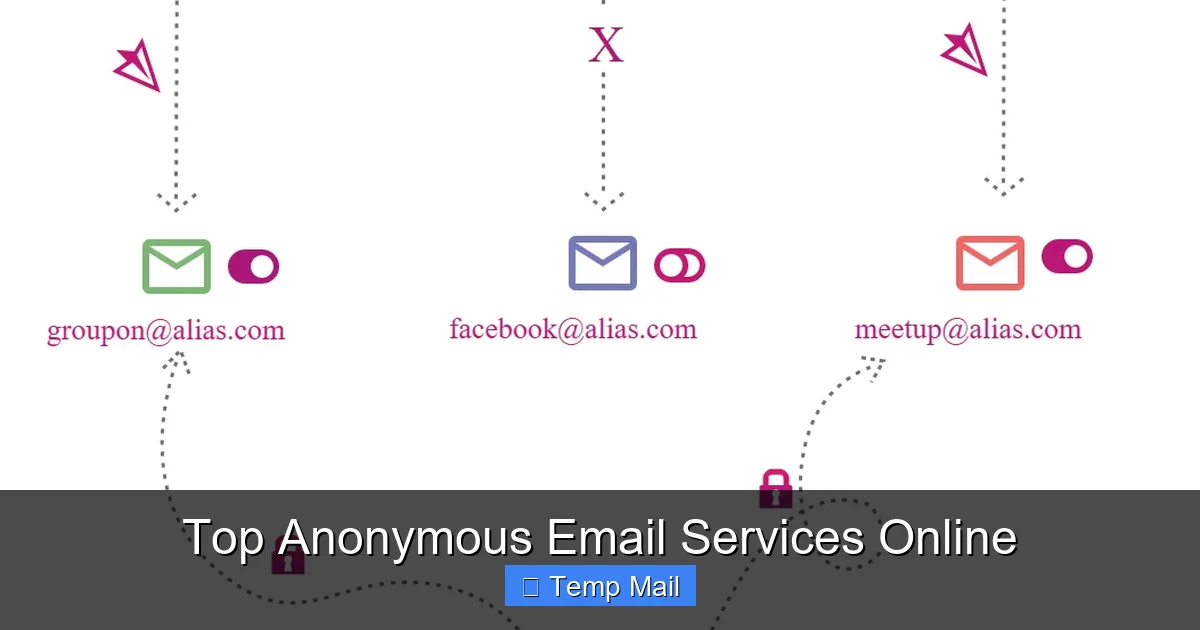
    Use Aliases and Unique Answers

    When setting up security questions (if the service uses them), never use real answers. Use a password manager to generate and store fake answers (e.g., “First pet’s name? Answer: BlueCoffee42!”). If the service offers alias features (like ProtonMail’s “plus addressing” or custom domains), use them. Instead of your main anonymous address, use a unique alias for each site (e.g., [email protected], [email protected]). This lets you track breaches and filter easily without revealing a single, catch-all address.

    Debunking Common Myths and Misconceptions

    Let’s clear the air about what these services can and cannot do.

    Myth 1: “Anonymous Email is Illegal.”

    False. Wanting privacy is not a crime. These are legitimate businesses operating under the law. Using them for illegal activities (fraud, threats, selling drugs) is, of course, illegal, but the tool itself is not. Many privacy advocates, journalists, and everyday citizens use them lawfully.

    Myth 2: “If It’s Encrypted, It’s Completely Anonymous.”

    False. Encryption protects the *content* of your message. It does not automatically hide your *identity*. If you signed up with a phone number (as many services require for 2FA), that number can be a link. If you access it from your home IP without a VPN, that IP is a link. True anonymity requires hiding the metadata of *who is communicating with whom* and *from where*, which is much harder.

    Myth 3: “Disposable Emails are Secure for Private Chats.”

    Dangerously False. The public inbox feature of disposable services means anyone who stumbles upon the URL can read your messages. They are for receiving a single link or code, not for back-and-forth conversations. Never use them for anything sensitive.

    Myth 4: “Free Means Trustworthy.”

    Not Necessarily. The business model matters. A free service that shows ads might still track you to target those ads. A free tier from a reputable paid service (like ProtonMail) is usually sustainable and trustworthy because it’s a loss-leader for their premium plans. Always read the privacy policy. If it’s vague or says they may share data with “partners,” avoid it. “If you’re not paying for the product, you *are* the product” holds especially true in the privacy space.

    The Bottom Line: Your Privacy is a Practice, Not a Product

    Anonymous email services are powerful tools in your privacy toolkit. For spam and one-off sign-ups, a disposable service like Temp-Mail is a perfect, effortless shield. For any communication you want to keep truly private—with a lawyer, a journalist, a colleague, or a loved one—you must use a secure, encrypted provider like ProtonMail or Tutanota. But remember, the service is only one layer. Your habits are the other 90%. Using a strong, unique password, enabling 2FA (with an authenticator app, not SMS if possible), accessing your account over a VPN or Tor, and never mixing your identities are non-negotiable practices. Start by auditing your current email use. Which accounts are tied to your primary email that could be separated? Which newsletters do you really need? Take one step today: create a disposable account for the next non-essential sign-up, or begin the process of moving one important contact to a secure email. Your future, less-spammed, more secure self will thank you.

    Frequently Asked Questions

    Is using an anonymous email service legal?

    Yes, using anonymous email services is perfectly legal in most countries. They are legitimate privacy tools. However, using them for illegal activities like fraud, harassment, or threats is, of course, illegal. Services have Terms of Service that prohibit illegal use and may cooperate with law enforcement for serious crimes.

    Are temporary/disposable emails safe?

    They are safe for their intended purpose: receiving a single verification link or code without giving away your main address. They are not safe for private conversations because the inbox is publicly accessible to anyone with the URL. Never use them for sensitive personal, financial, or login information.

    What is end-to-end encryption (E2EE) and why does it matter?

    End-to-end encryption means your email is encrypted on your device and can only be decrypted by the intended recipient’s private key. Not even the email service provider can read the content. This matters because it prevents hackers from stealing your emails from the provider’s servers and stops the provider itself from scanning your messages for ads or handing them over to governments without your knowledge.

    Can free anonymous email services be trusted?

    It depends on their business model. Free tiers from reputable paid services (like ProtonMail or Tutanota) are generally trustworthy as they are funded by subscriptions. Free services that rely solely on ads may still track you to target those ads. Always read the privacy policy. Look for services based in privacy-friendly jurisdictions, with clear, transparent policies and independent security audits.

    Does using an anonymous email hide my IP address from the recipient?

    Not by itself. When you access your email provider’s website or app, your ISP sees your IP. The email provider may log it. The “Received:” headers in the email itself can sometimes contain the IP address of the client that sent it. To hide your IP, you must use a VPN or the Tor Browser when accessing your anonymous email account.

    What is the best anonymous email for whistleblowing or high-risk activism?

    For high-risk scenarios, you need maximum security and anonymity. This typically means using a secure, encrypted service like ProtonMail or Tutanota accessed exclusively through the Tor Browser. You should create the account with a pseudonym, using a VPN/Tor, and without providing a phone number if possible. Always assume your device could be compromised and follow operational security (OPSEC) guidelines from trusted digital security organizations.

  • Temp Mail for Developers and Testers

    Temp Mail for Developers and Testers

    Temp mail services are essential for developers and testers, enabling them to streamline critical workflows like user registration and email verification without compromising personal or corporate inboxes. These tools automate sign-ups for multiple test accounts and avoid spam cluttering primary emails, ensuring clean, reproducible testing environments and protecting privacy.

    Key Takeaways

    • Prevent spam: Use temp mail to keep your primary inbox free from test-related spam.
    • Automate verification: Streamline email confirmation steps with disposable addresses.
    • Protect privacy: Safeguard personal and client data during development testing.
    • Integrate easily: Add temp mail APIs to your CI/CD pipelines without hassle.
    • Test safely: Verify email triggers without sending to real users accidentally.
    • Scale effortlessly: Generate unlimited test emails for load testing and QA.
    • Ensure compliance: Avoid storing permanent emails in test environments.

    Why Your Inbox is a Developer’s (and Tester’s) Secret Nightmare

    Let’s be honest. How many times have you sighed, clicked “Create Account” on a new tool, and then braced yourself? You know the drill. You type in your real, precious, carefully-guarded professional email address. You confirm. And then… the floodgates open. promotional newsletters you never wanted, “important updates” that are just ads, and a creeping sense that your primary inbox has just been violated. For developers and testers, this isn’t just an annoyance; it’s a productivity killer and a security risk. What if I told you there’s a simple, elegant weapon against this digital spam avalanche? It’s called temp mail, and it’s about to become your new best friend in the dev cycle.

    I remember the early days of my testing career. I’d use a throwaway Gmail account for everything. It worked, sort of. But managing that separate inbox was a chore. Passwords got lost. Important verification emails for a critical API test would get buried under a mountain of “You won a free iPhone!” spam. It was messy. Then I discovered purpose-built disposable email services. It wasn’t a magic bullet, but it was a massive upgrade. It felt like finally putting on noise-cancelling headphones in a chaotic open-office environment. This guide isn’t about selling you on a specific service; it’s about sharing the mindset, the techniques, and the honest pros and cons of using temporary email as a core tool in your development and testing toolkit.

    What Exactly is Temp Mail? More Than Just a Spam Filter

    At its core, a temp mail service provides you with a random, temporary email address and a public inbox to go with it. You don’t sign up. You don’t use a password. You simply visit a website, get an address like [email protected], and start using it. That address and its inbox exist for a short, predefined period—usually 10 minutes to a few hours—or until you manually delete it. The moment you close the browser tab, that digital identity can vanish into the ether.

    Temp Mail for Developers and Testers

    Visual guide about Temp Mail for Developers and Testers

    Image source: shakebugs.com

    The Core Mechanics: How It Actually Works

    These services run on a simple but powerful architecture. They own a domain (or several) and have systems that automatically generate unique inboxes on the fly. When an email is sent to your temporary address, their mail servers receive it and render it in a web-based interface. There’s no persistent storage linked to your identity. Once the inbox times out or is cleared, the data is typically purged. For us as testers, this means a clean, isolated environment for every single test run, free from the baggage of previous sessions.

    Temp Mail vs. Your “Fake” Gmail Account: A Crucial Distinction

    You might be thinking, “Why not just create another permanent email account?” This is a common first step, and it’s better than using your main work email, but it has fatal flaws for serious testing:

    • Persistence is the Enemy of Clean Testing: That “fake” Gmail account accumulates emails over months. A test you run today might be influenced by a verification email from a test you ran six weeks ago. With temp mail, you start from absolute zero every time.
    • Management Overhead: You have to remember the password, log in, manage labels, and eventually clean it out. It’s an admin task that steals focus.
    • Traceability & Bloat: If you’re testing user registration flows, having a permanent email address linked to your IP or browser fingerprint can sometimes create weird edge cases in analytics or user databases. A fresh, anonymous temp address is truly isolated.

    Why Developers and Testers Live and Breathe by Disposable Email

    So, we’ve established it’s clean and simple. But why is it essential? Because it solves specific, painful problems that crop up daily in our workflows.

    Temp Mail for Developers and Testers

    Visual guide about Temp Mail for Developers and Testers

    Image source: tempmailmaster.io

    1. Testing User Registration and Onboarding Flows

    This is the #1 use case. You need to verify that:

    • The “Sign Up” form accepts an email and sends a verification link.
    • Clicking that link correctly activates the account.
    • The welcome email content is formatted correctly and contains the right links.
    • Resending the verification email works.
    • The “Forgot Password” flow generates and sends a reset link.

    With temp mail, you can script or manually run this entire cycle 20 times in an hour, using a brand-new, clean address for each iteration. No logging into different accounts. No worrying about hitting provider limits. You just generate, test, discard, repeat. It’s pure, frictionless validation.

    2. Safely Exploring Third-Party Services and APIs

    Need to test an integration with a new email marketing service, a CRM, or a social login provider (like “Sign in with Google”)? You don’t want to tie your real credentials or company email to an experimental service that might spam you or have poor data handling. A temporary address lets you:

    • Complete the OAuth handshake or API key generation process.
    • Receive and parse the test webhook payloads or notification emails those services send.
    • Verify the data structure and content without exposing a real identity.

    Once the integration is confirmed, you revoke the test credentials and walk away. The temporary email address becomes irrelevant, taking any potential spam with it.

    3. QA for Email-Dependent Features Without the Spam

    Many applications have features built around email: weekly digest newsletters, alert systems, comment reply notifications, etc. Testing these used to mean signing up, waiting, and then sifting through a ton of marketing emails to find the one transactional email you care about. Now, you use a temp mail address solely for the feature under test. Your inbox is a pristine, single-thread view of the exact emails the application is programmed to send. This dramatically speeds up visual verification and debugging.

    How to Integrate Temp Mail Into Your Daily Workflow: A Practical Guide

    Knowing *why* to use it is one thing. Knowing *how* to weave it seamlessly into your process is where the real efficiency gains happen. Here’s how I do it, and how you can too.

    Temp Mail for Developers and Testers

    Visual guide about Temp Mail for Developers and Testers

    Image source: cms.juhedata.cloud

    The Manual Tester’s Quick-Start Routine

    1. Bookmark Your Go-To Service: Pick one reliable temp mail provider (we’ll compare them later) and bookmark it. I use two: one for quick manual tests, another with API access for automation.
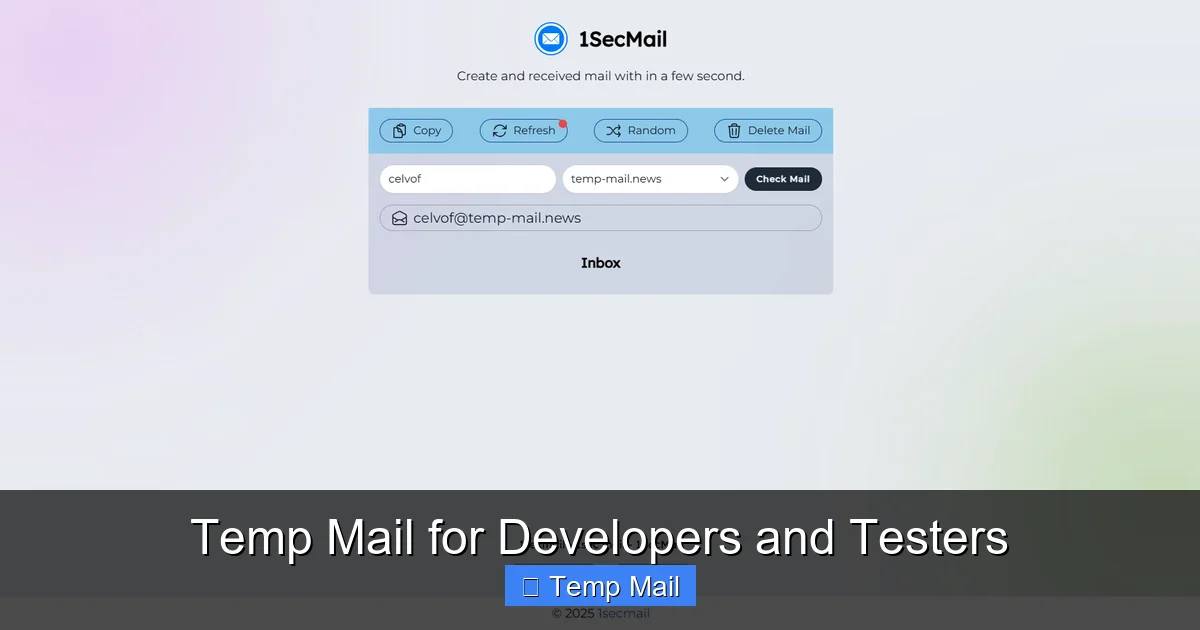
    2. Generate & Copy: Open the bookmark. Instantly, you have an address. Click the “Copy” button next to it.
    3. Paste & Test: Paste it into the application’s email field. Proceed with your test case—registration, password reset, etc.
    4. Switch Back & Refresh: After triggering the action, switch back to your temp mail tab and hit refresh. The email should appear within seconds.
    5. Inspect & Act: Click the email to view its full content. Check links, copy activation codes, verify formatting. Once done, you can either let the inbox expire or manually delete it to free up the address (some services reuse addresses after deletion).

    Automation and Scripting: The Power User’s Edge

    This is where temp mail transforms from a handy tool to a force multiplier. Many services offer a simple REST API. Here’s a conceptual Python snippet using a hypothetical API:

    import requests
    import time
    
    # 1. Get a new temporary email address
    response = requests.get('https://api.tempmail.service/address')
    email_data = response.json()
    test_email = email_data['email']
    inbox_id = email_data['id']
    print(f"Using test email: {test_email}")
    
    # 2. Use this email in your automated test (e.g., Selenium, requests)
    # ... your code to fill form and submit with test_email ...
    
    # 3. Poll the API for incoming messages
    timeout = 30  # seconds
    start_time = time.time()
    while time.time() - start_time < timeout:
        messages = requests.get(f'https://api.tempmail.service/inbox/{inbox_id}').json()
        if messages:
            print(f"Received {len(messages)} emails!")
            # Parse the first message for a verification link or code
            verification_link = extract_link(messages[0]['body'])
            break
        time.sleep(2)
    else:
        raise Exception("Verification email not received within timeout")

    This script automates the entire cycle: address generation, form submission, inbox polling, and extraction. You can run hundreds of these in parallel, each with its own isolated temp mail session, achieving a scale of testing that would be impossible manually.

    Not all temp mail services are created equal. Some are built for one-off consumer use, while others cater specifically to developers. Here’s a breakdown of key features you should care about.

    Feature Why It Matters to Devs/Testers What to Look For
    API Access & Documentation Essential for automation and CI/CD pipeline integration. Clear REST API docs, authentication methods (API key), rate limits, and example code snippets.
    Inbox Persistence Time Determines your test window. Too short, and emails vanish before you can inspect them. Options for 10min, 1hr, 24hr, or custom durations. 1-2 hours is the sweet spot for most manual/automated tests.

    Domain Variety Some applications block known disposable email domains. More domains = higher chance of bypassing filters. Service provides multiple domains (e.g., @tempmail.demo, @10minutemail.com, @discard.email).
    Email Format Support Modern apps send HTML emails with CSS, images, and buttons. Your test might rely on these. Full HTML rendering, not just plain text. Ability to view raw source is a bonus.
    No CAPTCHA on Site CAPTCHAs break automation scripts. If the temp mail site itself has one, it’s a non-starter for CI. Instant access to inbox without solving puzzles.
    Privacy & Data Handling Policy Are your test emails logged? Who has access? This matters for sensitive project data. Clear statement that emails are not logged, not monitored, and are deleted immediately after expiry.

    My Personal “Go-To” Shortlist

    Based on my testing, here are two categories of services I rely on:

    • For Quick Manual Checks: Temp-Mail.org or 10MinuteMail.com. They are fast, have no sign-up, and the inboxes live long enough (10-60 mins) for a quick manual verification cycle.
    • For Automation & Serious Testing: MailSlurp or KillMail. These are built as developer tools first. They have robust APIs, SDKs for various languages, allow you to create “inboxes” with specific properties, and integrate cleanly with testing frameworks. They often have free tiers with enough capacity for individual projects.

    The Honest Truth: Pitfalls and Limitations You Must Know

    Using temp mail is powerful, but it’s not a silver bullet. Being a pro means knowing the traps.

    The Deliverability Blacklist Problem

    This is the biggest issue. Many email service providers (Gmail, Outlook, Yahoo) and even some SaaS platforms actively block emails from known disposable email domains. Why? To prevent spam and abuse. So, if you’re testing an app that sends emails to users (like a notification system), and you use a temp address as the recipient, that email might simply never arrive. The app will think it sent it successfully, but you won’t see it. The Fix: Always test your email-sending functionality with a real, permanent email address you control (a dedicated test account). Use temp mail for the incoming side of things—testing what your app does when it receives an email (e.g., parsing a reply, handling a bounce).

    Provider Reliability and Uptime

    Free temp mail services can be flaky. They might go down during peak hours, have slow inbox loading, or change their UI without notice, breaking your manual or automated workflows. The Fix: For critical test suites, use a paid developer-focused service with an SLA. For exploratory testing, have a backup service bookmarked. Don’t put all your eggs in one basket.

    It’s a Tool, Not a Strategy

    Relying solely on temp mail for all email-related testing is naive. A robust testing strategy for an email-heavy application includes:

    • Real Email Accounts: For end-to-end deliverability tests.
    • Temp Mail: For high-volume, isolated, inbound testing of your app’s email processing logic.
    • Email Testing Services (e.g., Mailtrap, Ethereal): These are like temp mail on steroids for developers. They provide a fake SMTP server. You configure your app’s email settings to point to their server in your test environment. All emails are “sent” to a secure, private inbox you control. This is the gold standard for testing email content, formatting, and SMTP configuration without ever touching the real internet. I use these for 80% of my backend email testing.

    The Future is Automated: Where Temp Mail Fits in Modern DevSecOps

    The trend in software development is toward ever-faster, more automated feedback loops. Temp mail is a perfect fit for this paradigm, but its role is evolving.

    Integration with CI/CD Pipelines

    Imagine this: your pull request triggers a GitHub Actions workflow. The workflow spins up a test environment, uses a temp mail API to get an address, runs a suite of end-to-end tests that include user registration and email verification, extracts a session token from the verification email, and then uses that token to run API tests against the new build—all without human intervention. This is not sci-fi; this is happening now. Temp mail APIs are becoming standard components in testing stacks, alongside headless browsers and cloud device farms.

    The Shift-Left Security Angle

    “Shift-left” means incorporating security and quality practices earlier in the development lifecycle. Temp mail aids this in two ways. First, it prevents testers and developers from using personal or corporate emails in test environments, reducing the risk of data leakage or phishing campaigns targeting your real identity. Second, it allows for rapid security testing of authentication and email verification flows, ensuring there are no vulnerabilities like email enumeration (where an attacker can probe your system to see if an email is registered) because each test uses a unique, anonymous address.

    Conclusion: Your Inbox Will Thank You

    Adopting temp mail isn’t about being sneaky or avoiding responsibility. It’s about being a pragmatic, efficient, and security-conscious professional. It’s about respecting the sanctity of your primary communication channels while ruthlessly optimizing your testing process. The next time you’re about to type your real email into a sign-up form for a new library, framework, or internal tool, stop. Open a new tab, grab a temporary address, and test with confidence. You’ll keep your inbox clean, your tests isolated, and your sanity intact.

    Start small. Use it for your next manual registration test. Then, explore the API of a developer-focused service and try to automate one simple flow. You’ll quickly see the compound time savings. In the world of development, where our attention is our most valuable currency, temp mail isn’t just a tool—it’s an investment in focus. Give it a try, and watch your testing friction disappear.

    Frequently Asked Questions

    What is a temporary email service for developers?

    A temporary email service provides disposable, short-lived email addresses that developers can use for account registration, API testing, or receiving verification codes without exposing their personal or primary work email. It helps maintain clean inboxes and separate testing environments from production communications.

    How can testers use temp mail in QA workflows?

    Testers leverage temporary emails to automate user journey tests that require email verification, such as sign-up, password reset, or notification flows. By programmatically accessing the inbox via an API, they can retrieve verification links or codes to complete test cycles without manual intervention.

    Is using a temp mail service secure for development?

    Reputable temp mail services prioritize security by not storing emails long-term and using encrypted connections, but they should never be used for sensitive, production-level communications. For development and testing, they provide a safe sandbox to avoid spam and potential data leaks from test accounts.

    Can I integrate a temporary email with my CI/CD pipeline?

    Yes, many temp mail providers offer APIs or webhooks that allow seamless integration into CI/CD tools like Jenkins, GitLab CI, or GitHub Actions. This lets automated tests create a new disposable address, trigger actions, and programmatically check for incoming emails within the pipeline script.

    Will temporary emails be delivered reliably for testing?

    For most common testing scenarios, temporary emails are delivered reliably in near real-time. However, some services may have slight delays or be blocked by certain providers' spam filters, so it's wise to choose a well-known service with high uptime and good deliverability reputation for critical tests.

    Are there limitations to using free temp mail for developers?

    Free tiers often have rate limits, fewer domain options, or shorter email retention times (e.g., 10 minutes to 1 hour), which can restrict complex or parallel test suites. For extensive automation, a paid plan with a dedicated API and longer inbox lifespan is usually more effective and reliable.

  • How to Avoid Spam Using Temp Mail

    How to Avoid Spam Using Temp Mail

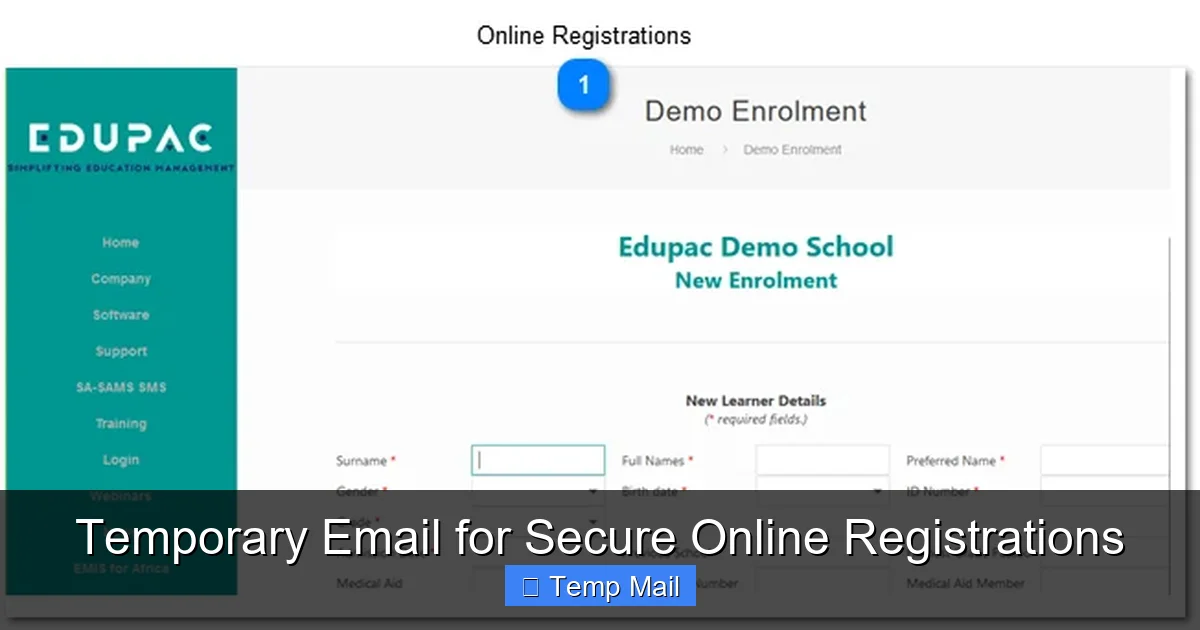
    Tired of your inbox being flooded with spam after every online sign-up? Temporary email—or temp mail—is your first line of defense. It provides a disposable, anonymous email address for one-time uses, shielding your real contact information from marketers, hackers, and data harvesters. By using a temp mail service for non-essential registrations, you block spam at the source, reduce phishing risks, and keep your primary email pristine for what truly matters.

    Key Takeaways

    • Temp mail is a shield: It creates a short-lived, anonymous email address to use instead of your primary one, preventing spam and data collection.
    • Use it for low-stakes sign-ups: Ideal for forums, free downloads, one-time discounts, and any website you don’t fully trust or plan to engage with long-term.
    • It’s not for everything: Never use temp mail for critical accounts like banking, main social media, primary cloud storage, or official government services.
    • Simplicity is key: Most services work instantly—visit a site, get an address, copy-paste, and forget. No registration or password needed.
    • Know the limitations: Inboxes auto-delete (often after 10 minutes to 1 hour), you can’t recover a “lost” temp address, and some sites actively block known temp mail domains.
    • Combine with other privacy tools: For maximum effect, use temp mail alongside a password manager, ad-blockers, and two-factor authentication on your real accounts.
    • It’s legal and ethical: Using a disposable email is a legitimate privacy practice, not a tool for fraud. It simply puts you in control of who can reach your main inbox.

    [FEATURED_IMAGE_PLACEHOLDER]

    What is Temporary Email (Temp Mail) and Why Should You Care?

    Let’s paint a familiar picture. You find a great article with a free e-book download. You click, and a pop-up demands your email address. You sigh, type in your primary Gmail or Outlook account, and hit submit. A few hours later, the e-book arrives. So does the first marketing email. Then another. And another. Within a week, that inbox you use for everything is clogged with newsletters, promotional offers, and “exclusive deals” from a site you visited once and forgot about. This is the spam cycle, and it starts the moment you hand over your real email address.

    Enter temporary email, often called temp mail. It’s a simple, powerful tool designed to break this cycle. In essence, temp mail provides you with a randomly generated, disposable email address that exists for a very short time—typically 10 minutes to 1 hour, sometimes up to 24 hours. You use this address for a specific, non-critical purpose, and then you simply abandon it. Any emails sent to it are automatically deleted when the address expires. The sender gets a valid email receipt, but your primary inbox remains blissfully untouched. It’s like using a burner phone for a quick call, but for your digital mailbox.

    The Core Problem: Your Email is a Golden Ticket for Data Harvesters

    Why is your primary email so valuable? Because it’s a persistent, unique identifier tied directly to your identity. Companies use it to build detailed user profiles for targeted advertising. Data brokers buy and sell email lists. If a website you use suffers a data breach, your email address—often with a password you reuse—is now in the hands of hackers. Spam isn’t just annoying; it’s a vector for phishing scams, malware, and identity theft. Every unnecessary sign-up with your real email increases your digital footprint and your risk. Temp mail acts as a firewall, containing that risk to a single, ephemeral address.

    How Temp Mail Works: A Step-by-Step Breakdown

    The beauty of temp mail lies in its utter simplicity. There’s no complex setup. Here’s exactly how it works, from zero to protection:

    How to Avoid Spam Using Temp Mail

    Visual guide about How to Avoid Spam Using Temp Mail

    Image source: imag.malavida.com

    Step 1: Visit a Temp Mail Provider Website

    Navigate to a reputable temp mail service like Temp-Mail.org, 10MinuteMail.com, or GuerillaMail.com. These sites are the generators. You do not need to create an account or provide any personal information to get started.

    Step 2: Instantly Receive Your Disposable Address

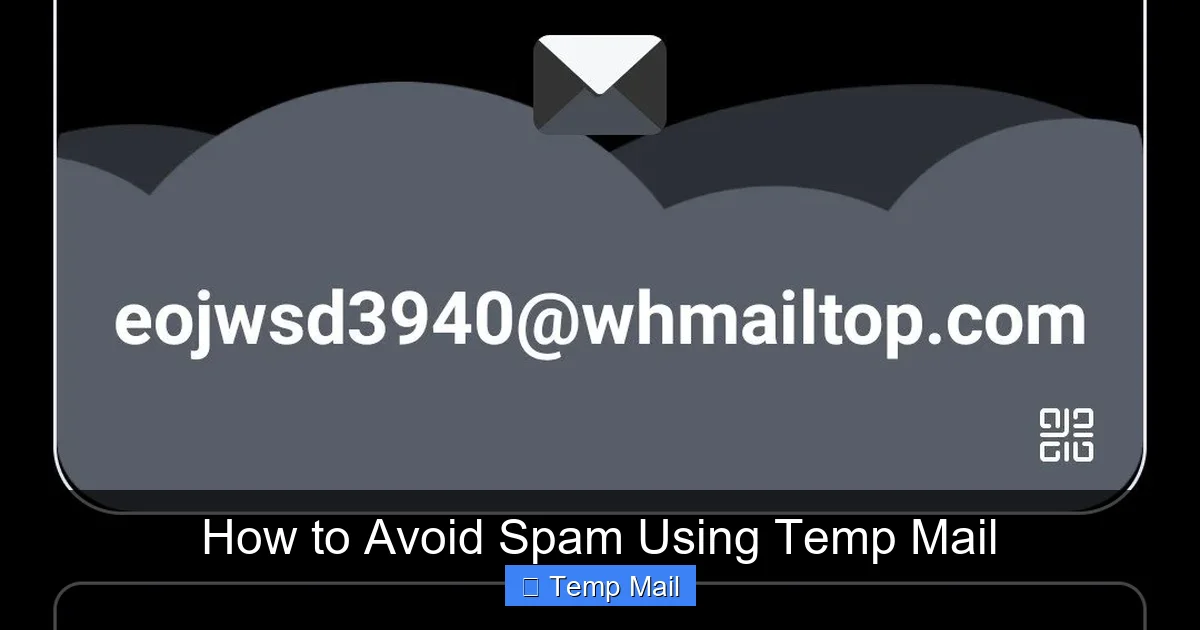
    The moment the page loads, the system generates a random email address for you. It will look something like [email protected] or [email protected]. The domain is owned by the service. This address is already active and ready to receive emails.

    Step 3: Use the Temp Address Anywhere You Need

    Highlight and copy the generated address. Paste it into any website’s sign-up or download form where an email is required. You might use it for:

    • Downloading a free PDF guide or template
    • Accessing a gated article or research paper
    • Signing up for a one-time discount coupon
    • Registering on a forum you’ll rarely visit
    • Creating a test account for an app or service

    Step 4: Check Your Inbox (If Needed)

    If you need to receive a confirmation link or the downloaded file, simply stay on the temp mail provider’s website. The inbox for your disposable address is visible right there on the page. Refreshing it will pull in new emails. Click on any email to view its contents and find links or attachments.

    Step 5: Walk Away. It Vanishes Automatically.

    This is the most important step. Once you’ve gotten what you needed (the download link, the confirmation code), you close the browser tab. You do not save the address. You do not try to remember it. After the predetermined time limit (clearly stated on the site), the entire inbox and the email address itself are permanently deleted from the server. Any future emails sent to that address will bounce. The trail goes cold.

    Critical Scenarios: When to Absolutely Use Temp Mail

    Knowing *how* to use temp mail is one thing. Knowing *when* to use it is what makes it an effective strategy. Think of your primary email as your home address. You wouldn’t give it to every random store clerk who asks for it. You’d give a PO box or a work address for certain things. Here are the prime scenarios where a disposable address is your best friend.

    How to Avoid Spam Using Temp Mail

    Visual guide about How to Avoid Spam Using Temp Mail

    Image source: temp-mail.io

    1. For One-Time Downloads and Content Gates

    This is the #1 use case. Countless blogs and marketers use “content upgrades”—free e-books, checklists, or webinars—in exchange for your email. The value of the content is often low, but the spam potential is high. Using temp mail here lets you grab the resource with zero commitment. The marketer gets their “lead,” and you get your file without future newsletters.

    2. For Anonymous or Low-Trust Forum/Community Sign-Ups

    Want to ask a question on a niche hobby forum or read comments on a controversial news site? Registering with your real email links that anonymous persona to your identity. A temp mail address allows you to participate without creating a permanent, searchable link to your main accounts.

    3. To Bypass “Email-Required” Software Trials

    Many SaaS tools and software downloads require an email for a trial license or download link. If it’s a tool you’re just testing for an hour, why clog your inbox? Use a disposable address. If you love the tool and decide to pay for it, you can always upgrade to your real email later.

    4. For Creating Throwaway Test Accounts

    Developing an app? Testing a new social platform? You might need multiple accounts to test features. Using your real email for each test is messy and unprofessional. Temp mail lets you spin up as many test accounts as needed, all isolated from your real identity.

    5. To Avoid “Newsletter” Traps After Retail Purchases

    You buy a pair of socks from an online store. At checkout, a pre-ticked box asks if you want to subscribe to their newsletter. Uncheck it! But if you miss it, you’ll be spam-blasted. If you foresee this, consider using a temp mail address for the entire purchase account on a site you don’t shop at regularly. It’s a more advanced move, but highly effective for one-off purchases from unfamiliar e-stores.

    What NOT to Do: Critical Limitations and Pitfalls of Temp Mail

    Temp mail is a fantastic tool, but it’s not a magic bullet for all your email needs. Using it incorrectly can cause real problems. Here’s where you must draw the line.

    How to Avoid Spam Using Temp Mail

    Visual guide about How to Avoid Spam Using Temp Mail

    Image source: loopify.com

    Never Use Temp Mail for Essential, Long-Term Accounts

    This is the cardinal rule. Do not use a disposable address for:

    • Banking, financial services (PayPal, Venmo), or investment accounts. You need secure, recoverable, and permanent communication for these.
    • Your primary email account (Gmail, Outlook, iCloud). You’d be locking yourself out instantly.
    • Major social media profiles (Facebook, Instagram, Twitter/X, LinkedIn). These are your digital identity. Recovery is key.
    • Cloud storage (Google Drive, Dropbox, iCloud). Access and recovery depend on a stable email.
    • Any account where password resets are sent via email. If the temp mail address vanishes, you lose access forever.
    • Official government services, healthcare portals, or legal documents. These require verifiable, persistent communication.

    You Cannot Recover a Lost Temp Address or Its Emails

    There is no “forgot password” for a temp mail inbox. The address is not tied to you. If you close the browser and later need to access a confirmation email that arrived in that disposable inbox, it’s gone. The service won’t retrieve it for you. This is by design for privacy, but it means you must use the inbox immediately and save any needed information (like a confirmation code or download link) before you leave the page.

    Some Websites Actively Block Temp Mail Domains

    Many savvy website owners and platforms know about temp mail services. They maintain and update lists of disposable email domains and will reject them during sign-up with an error like “Please use a valid email address.” If this happens, you’ve hit a wall. You’ll need to use your real email or find a different temp mail service that uses a less-common domain (though this is a constant cat-and-mouse game). Don’t try to trick sophisticated systems—it usually won’t work.

    Limited Attachment and Sending Capabilities

    Most temp mail services are designed for *receiving* emails only. You typically cannot send emails *from* a disposable address. Furthermore, they often block or filter attachments for security reasons (to prevent malware distribution). If the site you’re signing up for promises to send a downloadable file (like a software installer or PDF), test with a small temp mail first to see if the attachment comes through. Sometimes you’ll just get a link to a cloud storage location instead.

    Advanced Tips and Best Practices for Power Users

    Once you grasp the basics, you can optimize your temp mail strategy for even better privacy and efficiency.

    Rotate Services and Domains

    Don’t get attached to one provider. If a site blocks the domain from Service A, try Service B. Keep a mental list of 2-3 reliable temp mail sites. Some services also offer multiple domain options (e.g., @tempmail.demo, @tmpmail.org, @disposable.com). Switching between them can help evade simple domain-based blocks.

    Use Browser Extensions for Seamless Integration

    For the ultimate in convenience, consider a trusted browser extension like “Temp Mail” or “Simple Temporary Email.” These extensions add a button to your browser toolbar. With one click, they generate a new disposable address, copy it to your clipboard, and open a small pop-up inbox window. It streamlines the process from 5 clicks to 1, making it almost frictionless to use temp mail everywhere.
    Combine with a Dedicated “Spam” Email Address

    For services that block temp mail but are still low-trust (like a store you might shop at once a year), create a dedicated “junk” or “shopping” email address with a free provider. Use this *only* for retail newsletters and non-essential sign-ups. Keep it separate from your main personal and work emails. This creates a second line of defense when temp mail isn’t an option.

    Clear Your Browser Data After Use

    While temp mail services don’t track you, your browser can. If you’re particularly privacy-conscious, close the temp mail tab and clear your browser’s recent history and cookies for that site. This ensures no local trace is left on your machine linking that disposable activity to your browsing session.

    Know When to Abandon the Attempt

    If a website makes it incredibly difficult—requiring email verification just to view basic content, or blocking all disposable domains—ask yourself: “Is this content/service *really* worth compromising my privacy for?” Often, the answer is no. There are thousands of alternative resources. Learn to recognize when a site’s practices are overly aggressive and simply walk away.

    The Bigger Picture: Temp Mail as Part of a Holistic Privacy Strategy

    Relying solely on temp mail is like putting a lock on one door of your house while leaving the windows wide open. True digital privacy requires a layered approach. Think of temp mail as your first and most aggressive filter for unsolicited contact.

    Layer 1: The Disposable Shield (Temp Mail)

    Use it for all unknown, one-off, or low-value interactions where an email is requested. This stops the vast majority of spam at the source, preventing your primary address from ever being added to junk lists.

    Layer 2: The Dedicated Catch-All

    Your secondary “shopping” or “newsletter” email address is your second layer. Use it for retailers, newsletters you *might* want, and forums that reject temp mail. This keeps your main inbox for family, friends, and critical work.

    Layer 3: Fortify Your Primary Inbox

    Your real email is your crown jewel. Protect it fiercely.

    • Use a strong, unique password stored in a password manager.
    • Enable Two-Factor Authentication (2FA) everywhere it’s offered.
    • Be ruthless with unsubscribe links in the few newsletters you actually signed up for.
    • Use your email provider’s built-in spam filters and report phishing attempts.
    • Never use your primary email for public forums or comment sections.

    The Mindset Shift: From “What’s the harm?” to “What’s the value?”

    The final piece is changing your behavior. Before you enter your email—any email—into any form, pause. Ask: “What value do I get in exchange for this address?” If the answer is “a PDF I might read once” or “access to a site I’ll forget tomorrow,” the value is low. That’s a temp mail scenario. If the answer is “my online banking” or “communication with my doctor,” the value is high—that’s your primary, secured email. This simple cost-benefit analysis, powered by temp mail for the low-value exchanges, will dramatically clean up your digital life.

    Conclusion: Reclaim Your Inbox and Your Peace of Mind

    Spam is not an inevitable fact of internet life. It is a direct consequence of over-sharing your primary email address. Temporary email services offer a brilliantly simple, no-cost solution to this pervasive problem. By adopting the disciplined habit of using a disposable address for every non-essential, one-time interaction online, you build an impenetrable barrier between yourself and the majority of unsolicited, potentially harmful emails.

    Start today. The next time you see an email field on a website you’re casually browsing, open a new tab, visit a temp mail site, copy that disposable address, and paste it in. Get your download, get your confirmation code, and close the tab. Feel the satisfaction of knowing that address will vanish in an hour, taking any future spam with it. Your primary inbox will stay clean, your personal data will be more secure, and you’ll have taken a powerful, proactive step toward mastering your digital privacy. In the battle for your attention and your data, temp mail is a weapon you should always have loaded and ready.

    Frequently Asked Questions

    Is using temp mail legal and safe?

    Yes, using temporary email is completely legal and a recognized privacy practice. It is safe as long as you use it for its intended purpose—receiving non-critical emails. The risk lies in using it for important accounts where you need password recovery, which would result in permanent loss of access.

    Can I send emails from a temp mail address?

    Most temp mail services are designed for receiving emails only and do not allow you to send outgoing messages. Some advanced or paid services might offer limited sending capabilities, but for standard privacy protection, you only need to receive confirmation links or downloads.

    What happens to my temp mail inbox after the time expires?

    The entire inbox, along with the specific email address, is permanently deleted from the server. All emails are irretrievably destroyed. Any emails sent to that address after expiration will bounce back to the sender with an error.

    Will a website know I’m using a temp mail address?

    Yes, the website will see the domain of the disposable address (e.g., @tempmail.demo). Some sites block these domains outright. Others don’t care, as they just need a valid format to send a confirmation email. They cannot trace it back to your real identity.

    What if I need to recover an account later that I signed up with temp mail?

    You will not be able to. Since you cannot access the expired disposable inbox, you cannot receive password reset links. This is why the golden rule is to never use temp mail for any account you need to log into repeatedly or that holds valuable data or money.

    Are all temp mail services the same? Which one is best?

    Most free services function similarly: instant address, short lifespan, web-based inbox. Differences include the exact time limit (10 min vs. 1 hour), whether they offer multiple domain choices, and if they have browser extensions. For most users, any major, well-known service (like Temp-Mail.org or 10MinuteMail) will work perfectly. Choose one with a clear, ad-light interface and a lifespan that suits your needs.

  • Best Disposable Email Providers in 2026

    Best Disposable Email Providers in 2026

    Disposable email addresses are your first line of defense against spam, data harvesting, and inbox clutter. In 2026, the best providers offer more than just a temporary inbox—they integrate advanced privacy shields, one-click generation, and seamless browser extensions. This guide cuts through the noise to review the top services, helping you choose the perfect tool for signing up, verifying accounts, and browsing anonymously without compromising security.

    Remember that feeling? You go to download a free PDF or sign up for a cool new app. You excitedly type in your real, trusted email address—the one tied to your bank, your family, your entire digital life. Then, the spam starts. Not just a little. We’re talking a relentless, daily barrage of “special offers” and “you’ve won!” emails that your primary inbox’s spam filter somehow always lets through. It’s a digital rite of passage, and it stinks.

    What if you could have a secret, throwaway email address for exactly those moments? A digital smoke bomb you drop, let it do its job, and then vanish without a trace? That’s the promise of disposable email, or “temp mail.” But in 2026, it’s not just about avoiding spam. The best disposable email providers have evolved into sophisticated privacy tools, integrating directly into your browser and offering military-grade security for your temporary digital footprint. This isn’t your 2015 list of random websites. This is the definitive guide to the best disposable email providers in 2026, built for the modern, privacy-conscious user.

    Key Takeaways

    • Disposable emails are essential for digital hygiene: They create a barrier between your primary email and the noisy, risky parts of the web, preventing spam and data breaches.
    • The 2026 landscape favors speed and integration: Top providers now offer browser extensions, mobile apps, and instant generation with a single click, moving beyond basic web forms.
    • Not all temp mail is equal: Security protocols (like TLS encryption), inbox retention times, and domain reputation vary significantly between providers.
    • Use cases have expanded: Beyond sign-ups, they’re vital for accessing geo-blocked content, testing apps, and conducting secure, anonymous research.
    • Legality and ethics matter: Using disposable emails is legal, but misusing them for fraud or to evade legitimate bans violates most platforms’ Terms of Service.
    • The future is AI and blockchain: Emerging 2026 features include AI-powered spam filtering for temporary inboxes and blockchain-verified disposable identities.
    • Your primary email remains king for important accounts: Never use a disposable address for banking, primary cloud storage, or any service where account recovery is critical.

    Why Disposable Emails Are Non-Negotiable in 2026

    Let’s be clear: using a disposable email is no longer a “hacker trick.” It’s a fundamental practice for anyone who values their online privacy and sanity. The digital ecosystem of 2026 is more interconnected and data-hungry than ever. Every free service, every forum, every “free trial” is often a front for building a marketing profile. Your email address is the golden key to that profile.

    The Spam & Data Broker Problem

    When you use your primary email everywhere, you’re not just getting spam. You’re feeding data brokers. These companies compile vast databases of your online activities, linked directly to your email. That “free” e-book you downloaded? That’s a data point. That forum you commented on? Another. A disposable email severs this chain. It creates a siloed, temporary identity that can’t be tied back to your real self or your main accounts, effectively putting a stop to the profiling at the source.

    Security Against Breaches

    Data breaches are a weekly headline. When a service you signed up with (using your main email) gets hacked, your credentials are now in the wild. If you used a unique, disposable address for that service, the breach is contained. The compromised email is useless to hackers for accessing your other accounts. It’s a simple, powerful layer of security hygiene.

    Bypassing Geo-Restrictions & Censorship

    In 2026, internet censorship and geo-blocking are sophisticated. Journalists, researchers, and everyday citizens in restrictive regions often need to access tools, news sites, or platforms blocked by their government. A disposable email from a provider with servers in a neutral country can be the first step in creating an anonymous, unblocked digital identity to access vital information.

    The Top 6 Disposable Email Providers Reviewed for 2026

    Not all temp mail services are created equal. The winners in 2026 combine blazing speed, robust security, and user-friendly integration. Here are the standout providers, ranked by overall utility and trustworthiness.

    Best Disposable Email Providers in 2026

    Visual guide about Best Disposable Email Providers in 2026

    Image source: maketecheasier.com

    1. TempMail.org: The Gold Standard for Speed & Simplicity

    Best for: Instant, no-fuss sign-ups and one-time verifications.

    TempMail.org has perfected the core disposable email formula. Visit the site, and you have a working inbox in under two seconds. No registration, no captchas (usually), just pure, immediate utility.

    • Key Features: Real-time inbox loading, multiple domain options (e.g,@temp-mail.org, @tmpmail.org), browser extension for one-click generation from any web form, and a clean, ad-light interface.
    • Security: All connections use TLS 1.3 encryption. Emails are automatically deleted from servers after 24-48 hours, depending on load.
    • The 2026 Edge: Their new “Smart Domain” feature automatically selects the least-blocked domain based on the website you’re visiting, improving delivery success rates for verification emails.
    • Potential Drawback: The free version has a limit of ~50 emails per month per IP. Heavy users need the affordable Pro plan.

    2. Guerrilla Mail: The Veteran with Unmatched Longevity

    Best for: Long-term temporary projects (up to 60 days) and users who dislike change.

    Guerrilla Mail has been a staple for over a decade. In 2026, it remains a rock-solid choice, especially for projects that need a temporary inbox for more than a few days.

    • Key Features: You can choose your own email address from a list of available domains. Inboxes can be kept alive for up to 60 days with activity. Includes a basic password manager for the temporary inbox.
    • Security: Emails are stored encrypted at rest. The service has a strong, transparent privacy policy stating no logs of email content are kept after deletion.
    • The 2026 Edge: Integrated “Mask” feature. Instead of giving a site your temp mail, you give a Guerrilla Mail “mask” address that forwards to your temp inbox, adding an extra layer of abstraction.
    • Potential Drawback: The interface feels slightly dated compared to newer competitors. The free tier’s 60-day retention is generous but not infinite.

    3. 10 Minute Mail: The Epitome of Ephemeral

    Best for: Maximum security and absolute minimal digital footprint. The name says it all.

    When you need an email that truly vanishes, 10 Minute Mail is the tool. The countdown timer is the defining feature.

    • Key Features: The inbox and address self-destruct after 10 minutes by default (can be extended in 10-minute increments). Zero data storage policy. Completely anonymous, no IP logging beyond the session.
    • Security: The ephemeral nature is its security. Even if intercepted, the window for access is infinitesimal. All data is purged from RAM and servers upon expiration.
    • The 2026 Edge: Now offers a “Secure Mode” that requires a session-specific PIN to view the inbox, preventing shoulder surfing in public places.
    • Potential Drawback: The extreme temporariness is its main limitation. If a verification email is delayed, you could lose access. Not for anything requiring delayed retrieval.

    4. SimpleLogin (by Proton): The Privacy Ecosystem Integrator

    Best for: Users already in the Proton ecosystem or those wanting an alias manager that *can* act as disposable.

    Acquired by Proton (the makers of Proton Mail) in 2022, SimpleLogin is in a category of its own. It’s an email alias service that can easily function as a disposable provider, with the backing of a major privacy company.

    • Key Features: Create unlimited “aliases” (e.g., [email protected]) that forward to your real inbox (any provider). You can disable or delete an alias anytime, instantly stopping all mail. Works with any email, not just Proton Mail.
    • Security: End-to-end encrypted alias management. Part of the Proton ecosystem, subject to Swiss privacy laws. Aliases are not stored in plaintext.
    • The 2026 Edge: Deep browser integration. It auto-detects email fields on websites and offers to generate a new alias with one click. It also blocks trackers hidden in emails before they reach your main inbox.
    • Potential Drawback: It’s not *purely* disposable. The alias *can* be kept forever if you want. The free plan has a limit (15 aliases), and it requires linking a real inbox.

    5. AnonAddy: The Open-Source Power User’s Choice

    Best for: Tech-savvy users and those who want full control over their alias infrastructure.

    AnonAddy is a self-hostable or cloud-hosted email alias service. Its open-source nature and granular control make it a favorite among developers and privacy purists.

    • Key Features: Create custom domains (if you own one) or use the anonaddy.com domain. Wildcard rules (e.g., *@reddit.anonaddy.com*). PGP encryption support for forwarded emails. Detailed logs and statistics.
    • Security: Open-source code can be audited. Self-hosting option means your data never leaves your server. Supports 2FA for the dashboard.
    • The 2026 Edge: Advanced filtering rules. You can set an alias to automatically delete after 1 email received, perfectly simulating a disposable address with custom domains.
    • Potential Drawback: The interface is less polished than SimpleLogin. Self-hosting requires technical expertise. The free tier is limited to 5 aliases/month on the shared domain.

    6. MailDrop.cc: The No-Frills, High-Volume Workhorse

    Best for: Bulk account creation, testing, and situations where you need many addresses quickly.

    MailDrop.cc focuses on volume and simplicity. It’s a bare-bones service that excels at providing a public, searchable inbox for a given address.

    • Key Features: Public inboxes (anyone with the address can view the inbox). No password required. Simple, text-based interface. Can create custom addresses on the @maildrop.cc domain.
    • Security: Very low. Since inboxes are public by default, this is for *completely* non-sensitive use only. Emails are deleted after a few hours.
    • The 2026 Edge: Its API is widely used by developers for automated testing of email-based workflows. It’s the go-to for QA teams.
    • Potential Drawback: The public inbox model is a major privacy risk for anything personal. Anyone who guesses or finds your address can read your mail. Use only for public-facing, non-private verifications.

    How to Choose the Right Disposable Email Provider for You

    With these top contenders, how do you pick? It’s not about which is “best” overall, but which is best for *your specific need*. Ask yourself these questions.

    Best Disposable Email Providers in 2026

    Visual guide about Best Disposable Email Providers in 2026

    Image source: zerobounce.net

    What’s Your Primary Use Case?

    • For one-time sign-ups (e.g., downloading a whitepaper): 10 Minute Mail or TempMail.org. You need speed and utter disposability.
    • For accounts you might check a few times (e.g., a forum, a trial service): Guerrilla Mail. The 60-day window gives you breathing room.
    • For managing many online identities or newsletters: SimpleLogin or AnonAddy. Their alias management is superior for organizing multiple “disposable” identities.
    • For software testing/automation: MailDrop.cc (with caution) or the API-focused features of AnonAddy.

    How Important is Browser Integration?

    If you hate leaving your tab to open a new temp mail site, prioritize providers with browser extensions. TempMail.org and SimpleLogin have excellent, one-click extensions that fill email fields automatically. This is a game-changer for workflow efficiency.

    What’s Your Threat Model?

    • Basic Spam Prevention: Almost any provider will do.
    • Evading Targeted Advertising/Profiling: Use an alias service like SimpleLogin or AnonAddy. They create a unique, forwardable address for each site, making cross-site profiling impossible.
    • High-Risk Activities (e.g., whistleblowing, bypassing censorship): This requires maximum anonymity. Use 10 Minute Mail in conjunction with a privacy-focused browser (like Tor) and a VPN. Never log into any personal accounts from the same session.

    Are You Willing to Pay?

    The free tiers of these services are powerful for casual use. But for power users, paid plans (usually $2-$5/month) offer benefits like custom domains, higher email limits, longer retention, and priority support. SimpleLogin Pro and AnonAddy Premium are excellent investments for professionals.

    Advanced Use Cases: Beyond Just “Signing Up”

    Let’s expand your thinking. A disposable email is a versatile tool in your digital toolkit.

    Best Disposable Email Providers in 2026

    Visual guide about Best Disposable Email Providers in 2026

    Image source: zerobounce.net

    Creating a “Canary” for Data Breaches

    Use a dedicated disposable address *only* for a specific high-risk service (like a questionable forum or a data-aggregate site). If you start getting spam on that specific address, you know exactly which service leaked or sold your data. It’s a breach detection system.

    Accessing Region-Locked Content & Trials

    Many streaming services, software trials, or news sites offer different content based on your location. Using a disposable email from a provider with a UK or US domain, combined with a VPN set to that country, can help you access region-specific promotions or content libraries for research.

    Clean, Anonymous App Testing

    Developing an app that requires email sign-up? Use an API-connected service like AnonAddy or a script that generates addresses via TempMail.org’s API. You can automate the creation of thousands of unique email addresses to test your sign-up flow, password resets, and invitation systems without polluting your real inbox.

    Protecting Your Identity on Marketplaces

    Selling something on Craigslist, Facebook Marketplace, or a niche forum? Use a disposable email for all initial buyer communications. Once the deal is done, delete the address. This prevents a disgruntled buyer from finding your primary email and engaging in harassment or phishing.

    The Future of Disposable Email: 2026 and Beyond

    The temp mail space isn’t stagnant. The best providers in 2026 are innovating to meet new privacy challenges.

    AI-Powered Inbox Filtering (Even for 10-Minute Inboxes)

    Providers like TempMail.org are piloting lightweight AI models that run in your browser to categorize incoming verification emails (“Sign-up Code,” “Welcome,” “Promo”) instantly. This helps you find the one code you need in a potentially cluttered, short-lived inbox.

    Blockchain-Verified Disposable Identities

    Imagine a system where your disposable email address is backed by a zero-knowledge proof on a blockchain. You could cryptographically prove to a website that you are a unique, first-time visitor (preventing multi-account abuse) without revealing any actual email address or personal data. Projects like AnonAddy are experimenting with this for enterprise clients.

    Deep Browser & OS Integration

    The next step is no extension at all. Expect native integrations in privacy browsers like Brave or even at the OS level (think a built-in “Generate Temporary Email” button in your phone’s keyboard or desktop widget). The friction will drop to zero.

    The Ongoing Cat-and-Mouse Game

    As disposable email use grows, so do the tools to detect and block them. Advanced services in 2026 use behavioral analysis (how fast you fill forms, mouse movements) and maintain constantly updated blocklists of known temp mail domains. The top providers respond with ever-changing domain pools, CAPTCHA-solving services, and “human-like” interaction simulators to ensure delivery.

    Conclusion: Your Inbox, Your Rules

    The best disposable email providers in 2026 are more than just spam shields; they are a critical component of a modern digital privacy strategy. They empower you to interact with the web on your terms, giving out a meaningless token of an address instead of the keys to your digital kingdom.

    Start by identifying your core need. For most people, installing the browser extension for TempMail.org or SimpleLogin will solve 90% of problems instantly. For developers and power users, diving into AnonAddy’s API or self-hosting options unlocks incredible flexibility.

    Remember the golden rule: your primary email address is for your identity—your bank, your cloud storage, your close contacts. Everything else is fair game for a disposable. By strategically segregating your online life, you reduce spam, minimize breach damage, and reclaim your privacy. In 2026, that’s not just smart. It’s essential.

    Frequently Asked Questions

    Is using a disposable email address legal?

    Yes, using a disposable email is completely legal in virtually all jurisdictions. It’s a standard tool for privacy protection. However, using it to commit fraud, evade legal bans, or send illegal content is, of course, illegal regardless of the email type used.

    Are disposable emails safe from hackers?

    They are safe *for your primary accounts*. A secure disposable inbox itself could potentially be hacked if the provider has a vulnerability, but any data there is temporary and unlinked to your real identity. The safety comes from isolation: a breach of a temp mail service does not compromise your main email, social media, or bank accounts.

    What’s the difference between a disposable email and an email alias?

    A disposable email is typically a standalone, temporary inbox that self-destructs. An email alias is a forwarding address that sends mail to your *existing, permanent inbox*. Services like SimpleLogin and AnonAddy blur this line, offering aliases that can be deleted on demand, effectively making them disposable. The key difference is whether you have a separate, temporary inbox to check.

    Can websites detect I’m using a disposable email?

    Yes, many can and do. They maintain lists of known disposable email domains and block them at sign-up. This is why top providers in 2026 use constantly rotating domain pools and advanced delivery techniques. If a site blocks your temp mail, simply generate a new address from a different domain offered by your provider.

    What are the main limitations of disposable emails?

    They cannot be used for any account where recovery is important (banking, primary cloud storage). They often have limited lifespans (10 minutes to 60 days). Some websites actively block known temp mail domains. You cannot send email *from* a disposable address in most cases; they are receive-only.

    What’s the single best practice when using temp mail?

    Never, under any circumstances, use a disposable email for a service where you might need to recover your account or receive critical, long-term information. Always use your primary, secure email for financial services, primary password resets, and official government or medical correspondence. Reserve disposable addresses exclusively for low-stakes, one-off interactions.

  • Temp Email Services That Work with Most Websites

    Temp Email Services That Work with Most Websites

    Temp email services provide a disposable email address for signing up on websites without using your primary inbox. They are essential for avoiding spam, protecting privacy, and bypassing registration hurdles on sites with lax verification. Not all services work everywhere, so choosing a reliable provider with broad compatibility is key to a seamless experience.

    Key Takeaways

    • Privacy Shield: Your real email address remains completely hidden from websites, marketers, and potential data breaches.
    • Spam Prevention: Inbox clutter is eliminated because the temporary address expires, cutting off future unwanted emails at the source.
    • Zero Setup Hassle: No registration, password creation, or personal details are required to generate a working email address instantly.
    • Broad Website Compatibility: The best services consistently bypass verification on social media, forums, e-commerce sites, and gaming platforms.
    • Ephemeral by Design: Addresses and their inboxes self-destruct after a set time (10 minutes to 24 hours), ensuring no digital footprint remains.
    • Security Trade-off: While great for anonymity, avoid using them for critical accounts (banking, main social media) due to lack of recovery options.
    • Service Reliability Varies: Some websites actively block known disposable email domains; top services constantly adapt to stay functional.

    The Never-Ending Battle for Your Inbox (And How to Win It)

    Let’s paint a familiar picture. You want to download a useful PDF, enter an online contest, or quickly comment on a forum. The website asks for your email. You hesitate. You know that handing over your primary Gmail or Outlook address is like giving a stranger a key to your digital living room. It often leads to a tsunami of promotional newsletters, “special offers,” and who-knows-what-else, clogging your inbox for months. Even with unsubscribe buttons, the damage is done. Your email is now on a list, sold and resold. There has to be a better way, right?

    Enter the world of temporary email services. Think of them as digital bodyguards or burner phones for your online identity. They give you a real, functional email address that exists for a short, defined period—sometimes just 10 minutes, sometimes a day. You use it to get that one verification link, complete your task, and then walk away. The address, and all its potential spam, vanishes into the ether. But here’s the crucial question that determines everything: does this temporary address actually work where you need it to? A temp mail service that fails on the site you’re trying to access is worse than useless; it’s a frustrating waste of time. This article is your definitive guide to finding and using temp email services that work with most websites, cutting through the hype to give you practical, reliable solutions.

    Why Your Regular Email is a Spam Magnet (And Why Temp Mail is the Antidote)

    Before we dive into the “how,” let’s solidify the “why.” Your primary email address is a golden ticket for data brokers and marketers. Every time you use it online, you’re potentially adding it to another database. That free Wi-Fi sign-up at the coffee shop? That’s a list. That old forum you posted on a decade ago? That list is probably still active. This practice, called “list rental,” is a billion-dollar industry. Your consent is often assumed or buried in lengthy terms of service.

    Temp Email Services That Work with Most Websites

    Visual guide about Temp Email Services That Work with Most Websites

    Image source: ihaveapc.com

    The Privacy Domino Effect

    Once your email is out there, the effects cascade. One data breach at a company you once interacted with can expose your address. That exposed address is then used for “credential stuffing” attacks on other sites, or simply for more spam. Even if you meticulously unsubscribe, the initial “opt-in” has already happened. Temp mail breaks this chain at the very first link. Since the address is disposable and never linked to your real identity, it cannot be used to build a profile on you. It’s a one-time key that unlocks a door and then dissolves.

    Beyond Spam: Bypassing Registration Walls

    Not every site wants your email for marketing. Some use it as a basic, low-security user filter. Forums might want to reduce bot sign-ups. Code repository sites might use it to track contributions. News sites use it to enforce a “one-free-article” limit. In these cases, a temp email is a perfectly legitimate tool to access a resource you’re entitled to view without committing to a long-term relationship you don’t want. It’s about reclaiming control over your digital interactions.

    What Makes a Temp Email Service Actually “Work”? Key Features to Hunt For

    Not all disposable email providers are created equal. The difference between a smooth experience and a “blocked” message often comes down to a few critical features. When evaluating a service, you’re essentially asking: “Will this specific service’s email domain be recognized and accepted by the website I’m targeting right now?”

    Temp Email Services That Work with Most Websites

    Visual guide about Temp Email Services That Work with Most Websites

    Image source: ihaveapc.com

    1. Domain Reputation & Freshness

    This is the most important factor. Websites, especially large ones like Facebook, Twitter, or major gaming platforms, maintain dynamic “blocklists” of domains known to be used for disposable email. If a temp mail service’s domain (e.g., @tempmail.com) gets on that list, it’s game over. The best services constantly rotate their domains, use a wide pool of domain names, and have a reputation for being less abused by spammers. Look for services that don’t rely on just one or two domains. Services like Temp-Mail and Guerrilla Mail are famous for having a vast, changing array of domains, which helps them stay under the radar.

    2. Inbox Lifespan & Auto-Refresh

    How long do you have? Some services offer a mere 10 minutes, which is fine for a quick verification link. Others give you 1 hour, 6 hours, or even 24 hours. Consider your use case. For downloading a file, 10 minutes might suffice. For a forum that sends a confirmation email that might take a few minutes to arrive, 30-60 minutes is safer. A crucial feature is auto-refresh. You don’t want to be staring at a static inbox page hoping an email arrives. The best services automatically check for new mail every few seconds and update the inbox in real-time.

    3. No Registration & Instant Access

    The entire point is speed and anonymity. A service that forces you to create an account, solve a CAPTCHA, or verify another email to get a temp address defeats the purpose. The top-tier services load a page, give you a random email address and an inbox URL, and you’re ready to go in under 3 seconds. The inbox URL is often unique to your session, meaning no one else can access your temporary emails.

    4. Browser Extension & Mobile App Support

    For power users, a browser extension (like for Chrome or Firefox) is a game-changer. It puts a temp mail button right in your browser toolbar, allowing you to generate an address and autofill web forms with a single click. Similarly, a dedicated mobile app makes the process seamless on your phone. This isn’t just a luxury; it’s a major indicator of a mature, user-focused service.

    5. Email Forwarding & Reply Capabilities (Advanced)

    Most use cases only require receiving a single verification link. But sometimes, you need to receive a password reset or a brief conversation. Some premium or advanced temp mail services allow you to forward emails from your temp address to your real one, or even send replies from the temp address. This extends its utility but also adds a layer of complexity and potential privacy leakage if not used carefully.

    The Front-Runners: Temp Email Services That Work with Most Websites in 2024

    Based on the criteria above—domain diversity, inbox reliability, speed, and compatibility—here are the standout services that consistently get the job done. They have proven track records of bypassing verification on a vast array of popular websites.

    Temp Email Services That Work with Most Websites

    Visual guide about Temp Email Services That Work with Most Websites

    Image source: ihaveapc.com

    1. Temp-Mail (temp-mail.org)

    Often considered the industry leader, Temp-Mail is the go-to for reliability. It boasts a massive, constantly rotating pool of domains (like @tempmail.com, @tmpmail.org, @tmpmail.net, and many more). This sheer volume makes it incredibly difficult for major websites to block them all. The interface is clean, the inbox auto-refreshes every 5 seconds, and it offers a handy browser extension. It’s my top recommendation for someone who needs a “set it and forget it” service that works 95% of the time on mainstream sites. The free version is more than capable for most users, with a 24-hour inbox lifespan.

    2. Guerrilla Mail (guerrillamail.com)

    The veteran. Guerrilla Mail has been around for over a decade and is synonymous with “disposable email.” Its domain list is also extensive and well-established. What sets it apart is its slightly more feature-rich free offering. You can not only receive but also send emails from your temporary address (within the same session). You can even choose from a list of available domain names to customize your address slightly (e.g., choosing a shorter or more memorable domain). Its longevity means many websites have its domains whitelisted by default because they’ve been “around so long.” The inbox lasts 1 hour by default.

    3. 10MinuteMail (10minutemail.com)

    As the name suggests, this service is brutally simple and fast. You get an address that lasts exactly 10 minutes. This is perfect for the most common use case: a single, immediate verification. There is literally no interface beyond the email address and the inbox list. It’s so lightweight that it often slips through blocks because it’s not trying to do too much. If you’re signing up for something and need the code right now, this is a fantastic, no-frills option. The countdown timer is clear and motivating.

    4. Maildrop (maildrop.cc)

    Maildrop takes a different approach: it uses a single, very clean domain (@maildrop.cc). Its strength lies in its simplicity and its focus on being a pure, no-ads, no-nonsense receiver. Because it’s minimalist and has a reputation for not being a spam hub, the @maildrop.cc domain sometimes gets a pass on sites that aggressively block other temp mail domains. It’s a great “plan B” if the big three above are being blocked. Inboxes last 24 hours but are public by default (though randomly named), so you shouldn’t use it for anything sensitive.

    5. Tempail (tempail.com)

    A strong European-based alternative with excellent domain rotation. It offers a very user-friendly interface with options to extend the inbox time (up to 3 days on some plans) and even generate a custom alias within their domains. Its domain list is distinct from the US-based services, which can be a huge advantage if a website has specifically blocked the common American temp mail domains. It’s a top-tier choice for users in regions where other services might be more heavily targeted.

    Practical Tip: Keep two of these services bookmarked. If you get a “blocked” error on one, immediately switch to the other. Their different domain pools mean a site blocking @tempmail.com might still accept @maildrop.cc.

    How to Use Temp Mail Like a Pro: A Step-by-Step Guide for Every Scenario

    Knowing which service to pick is half the battle. Using it correctly is the other half. Here’s how to deploy your temporary email effectively across common situations.

    Scenario 1: The Quick Download (e.g., Ebook, Template, Software Trial)

    This is the temp mail bread and butter. You want a file, and the site demands an email.

    1. Open your chosen temp mail service (e.g., Temp-Mail) in a new browser tab.
    2. Copy the generated email address (it’s usually displayed prominently).
    3. Paste it into the sign-up field on the download site.
    4. Click “Submit” or “Download.”
    5. Switch back to the temp mail tab. The inbox should auto-refresh and show the new email within 10-30 seconds.
    6. Open the email and click the download link or copy any access code.
    7. Done. Close the tab. The address and inbox are now someone else’s problem.

    Pro Tip: Do this in a private/incognito browser window if you’re concerned about cookies from the download site linking to your main browser profile. It’s not always necessary, but it’s an extra layer of separation.

    Scenario 2: Social Media or Forum Account Creation

    This is trickier. Platforms like Facebook, Instagram, Reddit, or Twitter have very sophisticated anti-bot and anti-spam systems. They will detect and block many disposable email domains.

    1. First, try a high-reputation service. Start with Guerrilla Mail or Temp-Mail. Their domains are the most likely to be accepted.
    2. If blocked, try a different domain from the same service. Some services let you click a button to get a “new address” with a different domain suffix. This can sometimes bypass the block.
    3. If still blocked, switch to your backup service. Use Maildrop or Tempail. Their different domain pools might work.
    4. Be prepared for additional hurdles. Even with a working email, these platforms may require a phone number verification for new accounts. A temp email won’t help with that. Decide if you truly want an account on that platform using a temp email, as you may hit a phone verification wall anyway.

    Critical Warning: Do not use temp mail for your primary, long-term social media accounts. You will be locked out forever if you lose access to the temp inbox and cannot reset your password. Use it only for throwaway, secondary, or testing accounts.

    Scenario 3: Online Shopping & Discount Codes

    Retail sites often require an email for a discount code or to access a sale. This is a prime temp mail use case.

    1. Generate a temp address.
    2. Use it to get the one-time code.
    3. Immediately use the code to make your purchase or access the sale.
    4. Do not expect order confirmations or shipping updates at the temp address! Before finalizing the purchase, always log into your account on the retail site and change the email to your real, primary address. This is non-negotiable. You need those shipping notifications and receipts.

    This two-step process (temp for gate, real for logistics) gives you the discount without signing up for a lifetime of marketing emails from that retailer.

    Common Pitfalls and Why Some Sites Still Block Temp Mail

    It’s not magic. Sometimes, the temp email is rejected. Understanding why helps you troubleshoot and set realistic expectations.

    The “Known Disposable Domain” Blocklist

    This is the most common reason. Large companies (like Google, Microsoft, Yahoo) and popular platforms maintain their own lists of domains they refuse to accept. They update these lists constantly. Your service’s domain might have been added yesterday due to abuse by spammers. There is no permanent fix from your side except switching services or domains.

    Advanced Email Validation Services

    Many websites don’t just check the domain; they use third-party validation APIs (like Kickbox, NeverBounce, or ZeroBounce) that score email addresses for deliverability and legitimacy. These services flag entire domains as “disposable” or “role-based” (like admin@, info@). If your temp mail domain is on their list, you’re blocked before you even hit “submit.” This is harder to bypass, as these services are used by major platforms.

    The “Catch-22” of Account Recovery

    Some sites, especially financial or critical service providers, have a policy: “If you forget your password, we will email a reset link to the address on file.” They know that if you use a temp email, you will be permanently locked out. To prevent a flood of support requests from locked-out users, they simply block temp emails at registration. This is a legitimate security and usability policy from their perspective. For these sites, you must use a real, permanent email.

    How to Respond When You See “Blocked” or “Invalid Email”

    • Don’t panic. It’s not you; it’s the domain.
    • Generate a new address. Often, within the same service, a different domain suffix (e.g., from @tmpmail.org to @tmpmail.net) will work.
    • Switch your service. Go to your backup provider immediately.
    • Accept defeat for that site. If all your temp options fail, the site is likely on a very aggressive blocklist. For a site you trust and need a real account on, use your primary email. For a site you don’t trust, maybe you don’t want an account there at all.

    The Future of Disposable Email: Smarter, Stealthier, More Integrated

    The cat-and-mouse game between temp mail providers and websites blocking them is eternal. The future of this niche isn’t about bigger inboxes; it’s about smarter evasion and deeper integration.

    AI-Powered Domain Generation

    Expect services to use AI to generate seemingly legitimate, random domain names that don’t fit the typical “temp,” “mail,” “disposable” pattern. Instead of @spamgourmet.com, you might get @novel-folder-87.net. These look like real, unrelated domains and are much harder to blacklist en masse.

    Seamless Browser & Password Manager Integration

    The next step is full automation. Imagine a browser extension that, upon detecting an email field on a webpage, automatically generates a temp address, fills it in, and opens the dedicated inbox in a side panel. Even better, integration with password managers like Bitwarden or 1Password could store the temporary email address and the site it was used for, creating a private log of your disposable interactions.

    The “Privacy-First” Mainstream Adoption

    As privacy awareness grows, we may see mainstream browsers or operating systems building in a “disposable email” feature natively. Apple could add it to iCloud, Google to Chrome. This would legitimize the practice and put immense pressure on websites to accept these sanctioned, system-generated addresses, similar to how they must accept emails from major providers.

    Conclusion: Reclaim Your Digital Hygiene

    Your email address is the master key to your online identity. Treating it as a public commodity is a recipe for a lifetime of spam, data profiling, and security risks. Temporary email services are not a tool for nefarious activity; they are a fundamental tool for digital hygiene and self-preservation in the modern web. They empower you to say “no” to unwanted relationships and to access the resources you need without a side of marketing spam.

    The key is choosing the right tool for the job. By understanding what makes a service reliable—domain diversity, auto-refresh, and no-fuss access—and by having a couple of trusted providers like Temp-Mail and Guerrilla Mail in your arsenal, you can navigate the vast majority of website sign-up forms with confidence. Remember the core rule: use temp mail for access, not for identity. It’s your digital shield for one-off interactions, not the foundation of your permanent online presence. Start using one today for that next free download or forum sign-up. Experience the quiet joy of an inbox that doesn’t fill up with noise. That’s not just convenience; that’s peace of mind.

    Frequently Asked Questions

    Are temp email services legal to use?

    Yes, using a temporary email service is perfectly legal in most jurisdictions. They are legitimate tools for privacy protection. However, using them to commit fraud, evade bans, or engage in illegal activity is, of course, illegal. The service itself is a neutral technology.

    Are temp emails safe and private?

    For the user, they are very safe and private. The provider does not require your personal information, and the inbox is typically isolated. However, the emails themselves are not encrypted end-to-end, and the provider can technically read any email sent to that address. Therefore, you should never use a temp email for sensitive communications like password resets for important accounts or private messages.

    How long do temporary email addresses last?

    It varies by service. Common lifespans are 10 minutes, 1 hour, 6 hours, or 24 hours. Some services allow you to extend the time manually. After the expiration time, the address and all its emails are permanently deleted and cannot be recovered.

    Why would a website block a temporary email?

    Websites block disposable email domains primarily to combat spam, fraud, and abuse. Bots and malicious actors often use temp emails to create fake accounts, post spam, or launch attacks. By blocking these domains, the site raises the barrier to entry for such activities, protecting their platform and legitimate users.

    Can I send emails from a temporary address?

    Most basic temp mail services are receive-only. Some, like Guerrilla Mail, allow you to send emails from the temporary address during the same session. However, sending capability is often limited to prevent the service from being used for outbound spam. You should never rely on a temp email for ongoing correspondence.

    What is the best temp email service for beginners?

    For beginners seeking maximum compatibility and simplicity, Temp-Mail (temp-mail.org) is the top recommendation. It requires zero setup, has a huge pool of domains that work on most sites, auto-refreshes the inbox, and offers a useful browser extension. Its reliability makes it the easiest starting point.

  • How to Generate a Temp Mail Without Signup

    How to Generate a Temp Mail Without Signup

    Tired of spam clogging your primary inbox? Generating a temporary email address without any signup is the fastest, most private way to shield your real identity online. This guide shows you exactly how to get a disposable email in seconds, explores the top no-registration services, and reveals smart use cases for developers, shoppers, and privacy-conscious users. Learn to create, use, and discard temp mail effortlessly while staying safe.

    You’re trying to sign up for a new online service—a forum, a game, a discount newsletter. The site insists on verifying your email. You hesitate. Your primary inbox is already a war zone of promotional blasts and suspected phishing attempts. The thought of adding more fuel to that fire is exhausting. What if there was a way to get a valid, working email address for this single purpose, with zero commitment, no password to remember, and no trace left behind? Enter the world of temporary email, or “temp mail,” specifically the kind you can generate without any signup. It’s the digital equivalent of a public payphone: available for a quick, anonymous call and then forgotten. This isn’t about hiding malicious intent; it’s about a fundamental right to privacy and sanity in an inbox-crowded world. Let’s dive deep into exactly how you can harness this tool instantly.

    Key Takeaways

    • Instant Anonymity: True no-signup temp mail services provide an email address immediately, requiring zero personal information, registration, or password creation.
    • Core Purpose is Privacy: The primary goal is to protect your primary email from spam, data breaches, and unwanted marketing by using a disposable address for one-time registrations and verifications.
    • Inbox is Public & Temporary: Most services display all inboxes publicly on a shared domain. Emails auto-delete after a set time (usually 10 minutes to 1 hour), and the address itself expires.
    • One-Way Communication: These addresses are almost exclusively for *receiving* verification emails. You typically cannot send emails from them, making them unsuitable for personal correspondence.
    • Choose Reputable Services: Stick to well-known providers like Temp-Mail.org, 10MinuteMail, or Guerrilla Mail. Avoid obscure sites that may log IPs or inject ads.
    • Not for Critical Accounts: Never use temp mail for banking, primary social media, or any account where password recovery is essential. You will lose access permanently.
    • Legal & Ethical Use: Using temp mail is legal, but using it to fraudulently sign up for services, evade bans, or send spam violates terms of service and can be illegal.

    Understanding Temporary Email: The Disposable Inbox Explained

    Before we get to the “how,” let’s clarify the “what.” A temporary email service provides you with a random, functioning email address that exists for a very short period—typically 10 minutes to 1 hour. The entire system is designed for impermanence and anonymity.

    How Do Disposable Addresses Actually Work?

    These services operate on a simple but clever technical model. They maintain a large pool of domain names (like @tempmail.com, @10minutemail.com) and a corresponding pool of mail servers. When you visit the website, the server automatically generates a completely random username and pairs it with one of their domains. This creates your unique, temporary address, like [email protected].

    That address is now active on their mail server. Any email sent to it lands in a shared, publicly accessible inbox queue linked to that specific address. On the service’s website, you see an inbox view that shows emails destined for your random address. The magic is that the service doesn’t need to know who you are. The address itself is the key. There’s no account, no login, no “you.” Just a random string of characters acting as a mailbox identifier. After the time limit expires, the address and all its emails are purged from the system forever.

    Top No-Signup Temp Mail Services: Your Instant Options

    Not all temp mail services are created equal. The best ones for our purpose—no signup—share common traits: a clean, direct homepage with the inbox already visible, a clearly displayed temporary address, and a countdown timer. Here are the most reliable and user-friendly options available right now.

    How to Generate a Temp Mail Without Signup

    Visual guide about How to Generate a Temp Mail Without Signup

    Image source: gkccs.wordpress.com

    1. Temp-Mail.org: The Industry Standard

    This is arguably the most popular and feature-rich option. Visit temp-mail.org, and you’re greeted with a fully functional inbox and a randomly generated address immediately. You can click to copy the address, and it will automatically refresh to a new one if you want. The interface shows a clear countdown (usually 60 minutes) until the address expires. It also has a useful “Keep” button to extend the life of your current address for another hour. It handles basic HTML emails decently and has a minimal, non-intrusive ad model.

    2. 10MinuteMail.com: The Original Speedster

    As the name suggests, this service gives you a 10-minute window. It’s brutally simple. You land on a page with a giant email address and a timer counting down from 10:00. That’s it. No frills, no navigation. The inbox is right there below it. It’s perfect for when you need the absolute fastest verification and have no need for a longer window. If the timer runs out, you just refresh the page for a brand new address. Its simplicity is its strength.
    3. Guerrilla Mail: The Veteran with Options

    Guerrilla Mail (guerrillamail.com) has been around for ages and offers a bit more control. You get a random address, but you can also manually choose your username and from a selection of domains (like @grr.la, @sharklasers.com). The default timer is 60 minutes. A standout feature is the ability to “forget” your current address and generate a new one without refreshing, and it also allows you to reply to emails—a rare feature in the no-signup space, though with limitations.

    4. Tempail.com: User-Friendly and Fast

    Tempail provides a very clean, modern interface. The address is generated instantly, and you have a clear 60-minute countdown. One nice touch is a “Copy” button that’s always visible. It also offers a browser extension for even quicker access. The inbox layout is intuitive, showing sender, subject, and a preview pane. It’s a solid, no-nonsense choice.

    Step-by-Step Guide: Generating Your Temp Mail in Under 30 Seconds

    Using these services is intentionally frictionless. Here’s a universal walkthrough that applies to all the services mentioned above.

    How to Generate a Temp Mail Without Signup

    Visual guide about How to Generate a Temp Mail Without Signup

    Image source: s3-alpha.figma.com

    Step 1: Navigate to the Service Website

    Open your browser and go to your chosen provider’s URL (e.g., temp-mail.org). Do not search for “temp mail” on Google and click the first ad; go directly to the known, reputable site to avoid phishing copies.

    Step 2: Locate Your Auto-Generated Address

    Within a second of the page loading, look for the large text box or display field labeled “Your temporary email address:” or similar. You’ll see a random string of characters followed by the service’s domain (e.g., [email protected]). This is your disposable inbox. No form was filled. No button was clicked. It’s already yours.

    Step 3: Copy the Address

    Click the small “Copy” icon/button next to the address. This copies the full email to your clipboard. If there’s no copy button, highlight the text with your cursor and press Ctrl+C (Cmd+C on Mac). Accuracy is key here; a single mistyped character means the verification email will bounce.

    Step 4: Use It for Registration

    Paste (Ctrl+V) this temporary address into the email field of the website or app you’re signing up for. Proceed with the registration as normal. When that site sends a verification email, it will be routed to the temp mail service’s servers.

    Step 5: Check Your Disposable Inbox

    Switch back to the temp mail service tab in your browser. You should see a new email appear in the inbox list within seconds or minutes. Click on it to open and view its contents. Look for the verification link or code. You may need to click “Show content” or “View email” if it’s hidden. Copy the code or click the link (be cautious with links—open them in a private/incognito window if suspicious).

    Step 6: Complete Verification & Forget

    Paste the code or complete the action on the original site. Your task is done. You can now simply close the temp mail tab. The address will expire on its own. There is no need to log out or delete anything. The entire digital trail for that interaction vanishes with the address.

    Practical Use Cases: When and Why to Use No-Signup Temp Mail

    This tool isn’t just for avoiding newsletter spam. Its applications are broad and practical for everyday digital life.

    How to Generate a Temp Mail Without Signup

    Visual guide about How to Generate a Temp Mail Without Signup

    Image source: tmailor.com

    For the Casual User: Dodging Unwanted Marketing

    This is the most common use. You want to download a free PDF, access a gated article, or get a one-time discount coupon from a retail site. They ask for an email. Use a temp mail. You get the resource instantly, and your primary inbox remains pristine, free from the inevitable drip of promotional emails that follow such signups.

    For Developers & QA Testers: Streamlining Workflows

    Testing user registration flows, password resets, or email-based features in an app requires multiple email addresses. Creating real Gmail or Outlook accounts for each test is a massive hassle. A temp mail service allows a developer to generate a fresh inbox for every test case, verify the email was sent and formatted correctly, and then discard it. It’s an indispensable tool for efficient, anonymous testing.

    For Privacy-Conscious Browsers: Creating Throwaway Accounts

    Need an account on a forum you’ll only visit once? A temporary chat room? A comment section on a controversial news article? Using your real email ties that activity to your identity. A temp mail creates a complete barrier, allowing you to participate online without building a data profile linked to your main communications.

    For Accessing Geo-Restricted or Gated Content

    Some websites block content or offer different versions based on your IP or require an email to proceed. While not a VPN substitute, using a temp mail from a service with servers in a different region (some offer this) can sometimes bypass simple email-gated walls to view information that should be publicly accessible.

    Security and Privacy Considerations: What You’re Really Trading

    The convenience of temp mail comes with inherent trade-offs. Understanding these is crucial for using it safely and appropriately.

    The Illusion of Complete Anonymity

    While the service doesn’t ask for your email, it does see your IP address when you visit the site. A malicious or logging service could record that IP alongside the temporary address you generated. For high-stakes anonymity, this is a risk. For avoiding spam, it’s negligible. Also, the inbox is public. If someone else guesses or brute-forces your random address, they can see your verification email. The randomness makes this unlikely but not impossible.

    No Sending, No Recovery

    You must internalize this: you cannot send email from a temp mail address. The “From” field is locked. More critically, you cannot use it for account recovery. If you sign up for a social media account with a temp mail and then forget your password, you are locked out forever. The account is gone. This is why it’s only for low-stakes, one-time interactions.

    Malware and Phishing Risks

    The emails in your temp inbox are not scanned for malware. A verification email from a shady site could contain a malicious link. Always treat emails from unknown senders (which is all of them in a temp inbox) with suspicion. Hover over links to see the real URL before clicking. Better yet, if a verification link seems odd, try to find an alternative verification method on the signup site.

    Using a temp mail to circumvent a website’s ban (e.g., after being blocked from a forum) is a direct violation of their Terms of Service. Using it to create multiple accounts for fraud, spam, or to manipulate systems (like voting or giveaways) is often illegal. The tool itself is neutral, but your use case determines its legality and ethics.

    Best Practices for Responsible and Effective Use

    To get the most out of temp mail without falling into pitfalls, follow these guidelines.

    • Use Reputable Sources Only: Bookmark the known good services (Temp-Mail.org, 10MinuteMail, etc.). Never click on “temp mail” ads from search engines; they are often scam sites that steal data or inject malware.
    • Check the Expiry Timer: Always note how long your address is valid for (10 min, 60 min). If you’re signing up for a service that might take a while to send an email (some are slow), opt for a 60-minute service.
    • Never Use for Critical Services: Reinforcing the earlier point: banking, primary email, PayPal, Amazon, main social media—never. The risk of permanent lockout is 100%.
    • Refresh for a New Identity: If you’re using temp mail for multiple, unrelated signups (e.g., testing three different apps), generate a new address for each one. Don’t reuse the same disposable address across different services, as it links those separate activities together.
    • Close the Tab When Done: While the address expires on its own, closing the browser tab is a good habit. It prevents accidental reuse and clears the visual clutter.
    • Assume Everything is Public: Do not use temp mail for anything remotely sensitive. Do not request a password reset for any important account to a temp address. Do not use it for private communications.

    The Future of Disposable Email and Evolving Defenses

    As temp mail grows in popularity, websites are fighting back. Some now employ advanced detection systems that block known disposable email domains outright. Others require more complex verification, like phone numbers or CAPTCHAs. This arms race means the list of “acceptable” domains for temp mail is constantly changing. A domain that works today might be blocked tomorrow. This is why using established services is better; they maintain large, rotating pools of domains to stay ahead of blocks. The future likely holds more sophisticated user behavior analysis beyond just email domain checking, making the “no-signup” model both more necessary and more challenged. However, for the foreseeable future, the core need for a simple, anonymous inbox for one-time tasks ensures these services will remain a vital tool in the privacy toolkit.

    In conclusion, generating a temp mail without signup is a straightforward, powerful method to reclaim your primary inbox from spam and create a layer of anonymity for low-stakes online interactions. By understanding its mechanics—the instant address generation, the public shared inbox, the strict time limits—and by following the best practices of using reputable services for appropriate tasks only, you can wield this tool effectively and safely. It’s not a solution for everything, but for the specific problem of “I need to give an email to see this content/complete this signup, but I don’t want the aftermath,” it is perfect. Embrace the disposable inbox for what it is: a temporary shield for your permanent digital identity.

    Frequently Asked Questions

    Is using a temporary email address legal?

    Yes, using a temporary email service is completely legal. The service itself operates within the law. However, using it to commit fraud, evade legal bans, or send spam is illegal. Always use it for its intended purpose: protecting your primary email from unwanted contact.

    How long does a temp mail address actually last?

    It varies by service. Common durations are 10 minutes (10MinuteMail), 60 minutes (Temp-Mail.org, Guerrilla Mail), or sometimes up to 24 hours. The countdown is always displayed clearly on the service’s page. Once the time expires, the address and all its emails are permanently deleted.

    Can I send emails from a no-signup temporary address?

    Almost never. These addresses are designed solely for receiving emails. The “send” function is disabled on virtually all no-signup services. Their purpose is to let you receive a single verification or download link, not to establish a two-way communication channel.

    Is a temp mail truly anonymous?

    It is anonymous in the sense that the service does not require your real email, name, or password. However, the service itself can see your IP address when you visit the site. Additionally, the inbox for your random address is technically public—anyone who stumbles upon that exact random address URL could see the emails. For standard spam avoidance, this level of anonymity is sufficient.

    What happens if I don’t check my temp mail in time?

    If you don’t check the inbox before the countdown timer reaches zero, the email will be deleted along with the address. You will not be able to retrieve the verification code or link. You would then need to generate a new temporary address and restart the signup process on the original site, if they allow it.

    Are attachments safe to open in a temp mail inbox?

    Exercise caution. Emails in a temp inbox are not virus-scanned by the service. While most verification emails contain only text or simple links, a malicious sender could include a harmful attachment. Treat all unexpected attachments with extreme caution. If possible, avoid opening attachments from unknown senders in a disposable inbox.

  • Temporary Email for Secure Online Registrations

    Temporary Email for Secure Online Registrations

    Temporary email services provide disposable, short-lived email addresses perfect for one-time online sign-ups where you don’t want to use your personal or work email. They act as a powerful privacy shield, preventing spam, reducing data breach risks, and minimizing your digital footprint. While incredibly useful for registrations, forums, and downloads, they aren’t suitable for critical accounts like banking or primary services. Using them wisely is a key step in taking control of your online security and inbox hygiene.

    Key Takeaways

    • Primary Defense Against Spam: Temporary emails intercept promotional and unsolicited emails, keeping your primary inbox clean and organized.
    • Minimizes Data Breach Exposure: By using a disposable address for low-stakes sites, you prevent your real email from being sold or leaked in a data breach.
    • Enhances Anonymity: They allow you to access content or services without revealing your identity or primary contact information.
    • Not for Critical Accounts: Never use a temporary email for banking, main social media, password recovery, or any service requiring long-term, secure access.
    • Auto-Deletion is Key: These addresses and their inboxes are automatically erased after a short period (hours or days), ensuring no lingering digital trail.
    • Some Sites Block Them: Popular platforms and services actively block known temporary email domains to prevent abuse, so they aren’t a universal solution.
    • Tool, Not a Silver Bullet: Temporary email is one component of a broader digital hygiene strategy that includes strong passwords and 2FA.

    What Exactly Is a Temporary Email?

    Let’s talk about a simple yet powerful tool for your digital life. A temporary email—also called disposable, throwaway, or fake email—is a service that gives you a working email address for a very short time. Think of it like a burner phone, but for your inbox. You go to a website, they generate a random address for you (like [email protected]), and you can use it to sign up for a website, download a file, or access a gated piece of content. The inbox is usually accessible right on the site without a password. After a set time—often just 10 minutes to a few hours—the address and all its emails vanish into the digital ether. No trace, no clutter.

    How Does It Actually Work?

    The mechanics are beautifully simple. When you visit a provider like Temp-Mail, 10MinuteMail, or Guerrilla Mail, their system instantly creates a new email address on their domain. This address is linked to a temporary inbox stored on their servers. Any email sent to that address is routed to that specific, isolated inbox. You view these emails by refreshing the inbox page on their website. Crucially, there’s no long-term storage. Once the timer expires—which could be based on time since creation or time since last email received—the entire address and its contents are permanently deleted from their systems.

    • Generation: Instant, no sign-up required (usually).
    • Inbox Access: Via a public, unique URL tied to your session.
    • Lifespan: Pre-set by the provider (10 min, 1 hour, 1 day).
    • Deletion: Automatic and irreversible.

    Why Your Primary Email Address Is a Bullseye

    Your personal email address is more than just a communication tool; it’s a master key to your digital identity. Every time you use it to register for a new service, you’re handing over a piece of your privacy. That company now has your email, which they might use for their own marketing, sell to data brokers, or—worst of all—have stolen in a security breach. Once your email is out there, it’s nearly impossible to recall. Spam filters catch some, but unwanted newsletters and tracking pixels follow you. This is where the strategic use of a temporary email becomes your first line of defense. It creates a firebreak between your primary identity and low-trust, high-noise online interactions.

    Temporary Email for Secure Online Registrations

    Visual guide about Temporary Email for Secure Online Registrations

    Image source: swool.io

    The Spam Tsunami and the Data Broker Economy

    Consider this: you find a useful PDF guide that requires an email sign-up. You use your main Gmail address. That company now owns that lead. They might send you their weekly newsletter (which you never read), and their email platform might have a “partner” program that shares your engagement data. Months later, you’re getting spam from unknown companies you’ve never heard of. That’s often the data broker economy at work. Your email has been packaged and sold. A temporary email absorbs that impact. The spam goes to an address that will self-destruct, leaving your primary inbox pristine.

    The Mechanics: How to Use Temporary Email for Registrations

    Using this tool is refreshingly straightforward, but doing it correctly matters. Here’s the step-by-step workflow for secure registrations. First, navigate to a reputable temporary email provider site. You’ll immediately be assigned an address. Copy it. Then, go to the website or forum you want to join. Paste that disposable address into the registration email field. Complete any other required steps (like a CAPTCHA). Now, switch back to the temp mail provider tab. Refresh the inbox page. The verification email (or welcome email) from the service should appear within seconds or minutes. Click the link or copy any code directly from that temporary inbox to complete your registration on the target site. Done. You now have access without commitment.

    Temporary Email for Secure Online Registrations

    Visual guide about Temporary Email for Secure Online Registrations

    Image source: on4t.com

    Practical Example: Signing Up for a Forum

    Let’s say you want to join a niche hobby forum to ask a specific question. You’re not sure if you’ll stick around. Here’s the smart play:

    1. Open your temp mail service. Get an address (e.g., [email protected]).
    2. Go to the forum’s registration page. Fill in username, password, and paste the temp email.
    3. Submit. Immediately, check your temporary inbox. Find the “activate account” email from the forum.
    4. Click the activation link. Your account is now live on the forum.
    5. You participate, get your answer, and leave. The temp email expires a few hours later. The forum has a dead-end contact for you. No future spam from them. Your real email is safe.

    When the Verification Email Doesn’t Arrive

    Sometimes, the email takes longer than the temp inbox’s lifespan. Or the site’s email gets flagged as spam and filtered out by the temp provider. If you’re waiting and the inbox expires, simply generate a new temporary email and try the registration again. This is why it’s best to use these services for sites with instant or near-instant email verification. For services that might take hours to send a “welcome” series, a temporary address might not be the right tool.

    The Clear Benefits: Why You Should Consider This Habit

    Adopting the use of temporary email for appropriate registrations is a low-effort habit with high-security dividends. The primary benefit is, without a doubt, spam prevention. But the advantages cascade from there. It’s a fundamental practice for digital minimalists and privacy-conscious users. By compartmentalizing your online presence, you make it exponentially harder for advertisers, scammers, and data harvesters to build a cohesive profile of you. You also gain a layer of protection against credential stuffing attacks. If a site you used a temp email for gets breached, the leaked password/email combo is useless for attacking your primary accounts.

    Temporary Email for Secure Online Registrations

    Visual guide about Temporary Email for Secure Online Registrations

    Image source: emis.edupac.co.za

    Benefit 1: Reclaiming Inbox Sanity

    Your primary inbox should be for people you know and services you truly value. By funneling all “maybe” and “one-time” sign-ups through a disposable address, you ensure that your main inbox only receives emails you genuinely expect and want. This dramatically reduces cognitive load and the time spent manually unsubscribing from lists you never opted into meaningfully.

    Benefit 2: Limiting Your Digital Shadow

    Every online account is a node in your digital identity graph. Using a unique, ephemeral email for each minor site breaks that graph. Data brokers and advertisers thrive on linking your activity across sites via your email. A rotating set of temporary addresses makes that linking impossible, significantly degrading the accuracy of any profile built on your browsing habits.

    The Important Caveats and Limitations

    Let’s be clear: temporary email is a specialized tool, not a universal replacement for your primary email. It has significant limitations you must respect. The most obvious is the lack of persistence. If you need to receive an email weeks or months later—like a receipt, a warranty, or a password reset for a service you forgot you signed up for—the temporary email and its history will be gone. This makes it completely unsuitable for any account where future access is important. Furthermore, many reputable platforms—especially financial institutions, major social networks, and email providers themselves—actively block domains from known temp mail services. They see them as high-risk for fraud and spam. Your registration will simply be rejected if you try to use one.

    When NOT to Use a Temporary Email (The Absolute Nos)

    • Banking & Financial Services: You need secure, recoverable communication.
    • Primary Email Provider (Gmail, Outlook, etc.): Obvious, but worth stating.
    • Main Social Media Accounts: Recovery and security depend on a stable email.
    • Any Service with Subscription Payments: Receipts, renewal notices, and disputes require a permanent record.
    • Government or Official Services: Legal documents and official communications must be accessible.
    • Work or Professional Accounts: Never use for professional sign-ups or networking.

    The “Blocked Domain” Problem

    This is a practical hurdle. If you try to register on a site like Facebook, Twitter, or most SaaS platforms with a temp mail, you’ll get an error message like “Invalid email address” or “Please use a valid corporate or personal email.” These platforms maintain and constantly update blocklists of disposable email domains. It’s a cat-and-mouse game; new temp mail domains pop up, and blocklists update. So, even if you find a new provider, it might be blocked tomorrow. This is by design—these services are fighting spam and fake account creation.

    Best Practices for Smart and Safe Usage

    To get the most out of temporary email without shooting yourself in the foot, follow these guidelines. First, always use a reputable provider. There are shady sites that might log IPs or inject ads. Stick to well-known names with clear privacy policies stating they do not log or sell data. Second, use it *only* for the intended purpose: one-time access or verification. Never use it to create an account you intend to keep long-term. Third, do not use the same temporary address for multiple sites. The point is isolation. If Site A and Site B both have emails to “[email protected],” they (or a data broker) could potentially link those two anonymous activities back to the same ephemeral source. Generate a fresh address for each new low-stakes registration. Finally, and most critically, never, ever use a password you use anywhere else for an account registered with a temporary email. Since the email is transient, you cannot recover the account if you forget the password. Treat it as a single-use session.

    A Practical Workflow for the Privacy-Conscious User

    Here’s a concrete routine:

    1. Identify the Risk Tier: Is this site “high trust” (bank, main cloud storage) or “low trust” (unknown blog, free wallpaper site, forum)?
    2. Choose Your Tool: For low-trust, open your temp mail tab. For high-trust, use your primary email.
    3. Generate a Fresh Address: Don’t reuse an old temp address. Get a new one from your provider.
    4. Register & Verify: Complete the sign-up using the temp address. Verify immediately.
    5. Bookmark/Note if Needed: If you need to log in again soon (within the temp inbox’s lifespan), bookmark the login page and note the temporary email/password combo somewhere temporary. Accept that you will lose access.
    6. Forget It: Once you’re done with the site or the inbox expires, forget it. No recovery possible.

    What About Password Managers?

    Can you store a login for a temp email account in your password manager? Technically, yes, but it’s often futile. The value of a password manager is long-term recall. By the time you need that password months later, the email address and its inbox will be gone. You’ll be locked out anyway. Use a password manager for your real, persistent accounts. For temp mail accounts, treat them as “write-only” access: you get in, do the thing, and the key is destroyed.

    Alternatives and the Broader Privacy Toolkit

    Temporary email is one tool in a larger privacy and security ecosystem. For some use cases, other solutions might be better. Alias email services like SimpleLogin, AnonAddy, or Firefox Relay sit between your real inbox and the outside world. They create unique, forwardable aliases (e.g., [email protected]) that deliver to your main Gmail. You can disable an alias at any time, and it’s persistent as long as you want. This is great for newsletters and semi-regular services where you might want to keep the history but can kill the address if spam starts. It’s a more robust, controllable option than a purely temporary address. Another alternative is simply creating a dedicated “junk” email address with a free provider (like a second Gmail) solely for online sign-ups. This is less private (it’s a persistent account tied to you) but more reliable than a temp mail that might expire before you need it. The choice depends on your threat model: maximum anonymity and zero persistence = temp mail. Controlled persistence with forwarding = alias service. Low-effort separation = secondary permanent email.

    Comparing the Tools: Temp Mail vs. Aliases vs. Secondary Email

    Feature Temporary Email Email Alias (e.g., SimpleLogin) Secondary Permanent Email
    Persistence Minutes/Hours Indefinite (until disabled) Indefinite
    Forwarding No Yes, to your main inbox No (separate inbox)
    Best For One-time access, instant verification Newsletters, recurring-but-low-trust services Accounts you may need long-term but want to separate
    Blocked by Sites? Often Yes Rarely (uses your domain) No
    Control None (auto-delete) High (disable anytime) Medium (manage separate account)

    The Role of Browser Extensions and Privacy Browsers

    Some privacy-focused browsers and extensions are starting to integrate temporary email functionality directly. For example, Firefox has experimented with Relay, and certain VPNs bundle disposable email features. This integration makes the workflow even smoother—right-click to generate a temp email for a sign-up field. Keep an eye on this space as privacy tools converge.

    Frequently Asked Questions

    Is using a temporary email legal?

    Yes, absolutely. Using a disposable email address is perfectly legal. These services are provided as a tool for privacy and inbox management. The legality only comes into question if the address is used for fraudulent activities, which applies to any communication tool.

    Is temporary email safe from hackers?

    It’s generally safe for its intended purpose of shielding your primary identity. However, you should not use it for sensitive transactions. The inboxes are often not encrypted in transit or at rest like major providers, and the services themselves may have varying security standards. Never use a temp email for password resets on important accounts or for financial data.

    Can a temporary email be traced back to me?

    Not directly to your real identity through the email address itself, as it’s randomly generated and not tied to you. However, your IP address is logged by the temp mail provider when you access the inbox, and the site you sign up for logs the IP used during registration. For most users, this level of traceability is not a concern for casual, low-stakes sign-ups, but it’s not anonymous in the strictest sense.

    Why do so many websites block temporary email domains?

    Websites block them primarily to combat spam, fraud, and fake account creation. Temporary emails are commonly used to create numerous throwaway accounts for abuse, scraping, or bypassing bans. By blocking these domains, sites raise the cost of creating fake accounts, protecting their communities and resources.

    What are the best temporary email providers?

    Reputable providers include Temp-Mail.org, 10MinuteMail.com, Guerrilla Mail, and DropMail. Look for services that don’t require registration, have a clear privacy policy stating no logs, and offer a reasonable inbox lifespan (at least 30-60 minutes). Avoid any that bombard you with ads or ask for personal info to “unlock” features.

    Can I use temporary email for account recovery on important sites?

    Never. This is the cardinal rule. If you use a temporary email to sign up for an account you care about (like a social media profile or cloud storage), you will permanently lose access if you forget your password or get locked out. The email address and its inbox will be deleted, making account recovery impossible. Always use a stable, accessible email for any account you want to keep.

  • Temp Mail for Testing Websites and Apps

    Temp Mail for Testing Websites and Apps

    Temp mail services provide disposable email addresses perfect for testing website and app signup flows, email verification systems, and user onboarding without cluttering your primary inbox or risking privacy. By using these temporary inboxes, developers and QA testers can simulate real user scenarios, catch email-related bugs, and ensure smooth functionality while completely avoiding spam and data collection. However, not all temp mail services are reliable, and some websites actively block them—choosing the right tool and understanding best practices is crucial for effective testing.

    Imagine this: you’re a developer or a quality assurance (QA) tester. You’ve just built a beautiful new user registration flow for a web app. It asks for an email, sends a magic link, and asks for a password. Looks great! But before you mark the task as “done,” you need to test it. You need to see it work from the perspective of a real user. So, you do the obvious thing: you go to the signup page and enter… your personal email address.

    What happens next? A cascade of noise. The “Welcome!” newsletter you didn’t ask for. The “Update your preferences” ping. The inevitable data breach notification years later from a company you barely remember testing. Your primary inbox, once a sanctuary, is now a testing ground for spam filters. Your privacy? Compromised with every test account you create. And if you’re on a team, you’re sharing your personal email with colleagues, which is just… awkward.

    Enter the hero of our story: temporary email, or “temp mail.” It’s the secret weapon in the toolkit of anyone who builds, tests, or maintains digital products. But it’s often misunderstood. It’s not just for anonymous signups to dodgy forums. In the professional world, it’s a precise instrument for quality assurance, a shield for privacy, and a key to unlocking efficient, repeatable testing processes. This guide will walk you through everything you need to know about using temp mail for testing websites and apps, from the absolute basics to advanced, automated strategies.

    Key Takeaways

    • Temp mail is a dedicated tool for QA: It’s not just for avoiding spam; it’s a critical instrument for systematically testing email-dependent features in a controlled, repeatable way.
    • Privacy and inbox zero are the core perks: Your primary email stays pristine, and your personal data isn’t harvested by every test site you visit during development cycles.
    • Service reliability varies wildly: Some temp mail providers offer API access, custom domains, and long-lived inboxes, while others are too flaky or short-lived for serious testing work.
    • Websites fight back: Many platforms now detect and block known disposable email domains, so testers must rotate services and mimic real user behavior.
    • It’s a legal and ethical gray area: Using temp mail for testing is perfectly legitimate, but using it to bypass paywalls, create fake accounts for fraud, or violate Terms of Service is not.
    • Automation is the next frontier: Advanced testing suites integrate with temp mail APIs to automatically fetch verification codes and complete signup sequences without manual intervention.
    • Always have a fallback plan: Because temp mail can fail, your testing strategy should include a secondary method (like a dedicated test email) for critical path validation.

    What Exactly Is Temp Mail? More Than Just a “Spam Catcher”

    Let’s start with a clear definition. Temp mail is a service that provides you with a random, disposable email address and a corresponding inbox, accessible via a web browser, for a short period—usually from 10 minutes to a few days. No registration, no password, no personal details required. You visit a site like 10MinuteMail.com or Temp-Mail.org, it gives you an address like [email protected], and you use that anywhere you’d normally use an email.

    The Core Mechanics: How It Works Under the Hood

    These services operate on a simple but clever technical model. They maintain a pool of mail servers and generate unique email addresses on demand. When an email is sent to one of these addresses, the service’s mail server receives it and stores it in a database linked to that specific session (often identified by a cookie or a unique URL). You, the user, access your temporary inbox by revisiting the same URL or using the same browser session. Once the time limit expires or the inbox is cleared, the address and all its emails are purged from the system forever.

    This ephemeral nature is its superpower for testing. It creates a clean, isolated environment for each test case. There’s no history, no prior emails, no “forgot password” links from last week’s test. You start fresh every single time.

    Key Features That Matter to Testers

    Not all temp mail services are created equal. For professional testing, you need to look for specific features:

    • Auto-Refresh Inboxes: The inbox should update automatically or with a manual refresh button to see incoming emails in real-time, crucial for waiting on verification codes.
    • Email Content Display: It must render HTML emails correctly, not just plain text, because many verification emails are styled. You need to see links, buttons, and code snippets clearly.
    • Copy-to-Clipboard Functionality: One-click copying of email addresses, verification codes, and links is a massive time-saver during repetitive testing.
    • Reasonable Lifespan: 10 minutes is often too short for a complex signup flow that might involve manual steps. Look for services offering 1 hour, 1 day, or even configurable durations.
    • Domain Variety: Some websites block emails from common disposable domains (like @tempmail.com). Having access to a service with multiple domains (e.g., @guerrillamail.com, @mailinator.com) helps bypass these blocks.

    Why Testers and Developers Swear By It: The Core Benefits

    Using your personal email for testing isn’t just annoying; it’s unprofessional and introduces risk. Temp mail solves these problems head-on.

    Temp Mail for Testing Websites and Apps

    Visual guide about Temp Mail for Testing Websites and Apps

    Image source: is1-ssl.mzstatic.com

    The Spam Avalanche Problem (and the Inbox Zero Solution)

    Every test account you create is a potential spam subscription. Even if you unsubscribe, your email address is now on a list that gets sold and traded. Before you know it, your “work” email is getting offers for male enhancement pills and crypto scams. Temp mail contains the blast radius. The test account’s entire existence, and all its subsequent spam, is confined to a disposable inbox that self-destructs. Your primary inbox remains a place for actual human communication and critical alerts.

    Privacy Protection as a Testing Priority

    When you use your personal email on a test server—which might be a staging environment with less security than production—you are exposing your identity. That server log now has your email. If that test environment is ever compromised, your personal email is in the breach. Temp mail decouples your identity from your test activity. It allows you to test anonymously, which is especially important when testing competitor features or sensitive applications (like a health tech prototype). You are testing the functionality, not handing over your digital identity.

    Enabling True, Repeatable Test Scenarios

    This is the technical goldmine. A good test case is repeatable. You want to be able to run the exact same signup flow multiple times to verify a bug fix. If you use your personal email, the second time you try to sign up, the system might say “Email already exists.” You’re stuck. With temp mail, you get a brand-new, never-before-used email address every single time. You can script a test that says: “1. Generate new temp email. 2. Use it to sign up. 3. Check inbox for code. 4. Enter code. 5. Verify success.” This is the foundation of automated testing.

    How to Choose the Right Temp Mail Service for Testing

    You can’t just pick any temp mail site and expect smooth sailing. For testing, reliability and features are non-negotiable.

    Temp Mail for Testing Websites and Apps

    Visual guide about Temp Mail for Testing Websites and Apps

    Image source: swiftsalary.com

    The Must-Have Feature Checklist

    Before you adopt a tool, vet it against this list:

    • API Access: Can you programmatically request a new email address and fetch incoming messages? This is essential for integration with test automation frameworks like Selenium, Cypress, or Playwright.
    • Custom Domain Support: Some premium services let you use your own domain (e.g., [email protected]). This looks more legitimate and is less likely to be blocked by sophisticated email filters.
    • Inbox Persistence: How long does the inbox live? 10 minutes? 1 hour? 1 day? Match this to your longest expected test cycle.
    • No-Captcha or Frictionless Access: You don’t want to solve a CAPTCHA every time you need a new email during a rapid testing sprint.
    • Clear Display of Raw Email Source: Sometimes you need to inspect the raw headers of an email to debug deliverability issues. A “View Source” button is invaluable.

    Top Tools Compared for Different Use Cases

    For Quick, Manual One-Off Tests: 10MinuteMail or Temp-Mail.org. They are dead simple. Visit, copy address, test, forget. Perfect for a quick smoke test of a “forgot password” flow.

    For Slightly Longer Manual Sessions: Guerrilla Mail or Maildrop. They offer inboxes that last for hours or until you close the browser. Good for testing multi-step onboarding that might involve checking an email later.

    For Automated Testing / CI Pipelines: This is where you need a pro service. MailSlurp, Mailosaur, or Kickbox’s disposable inbox product are built specifically for developers. They provide robust REST APIs, SDKs for popular languages (Python, JavaScript, Java), and features like waiting for a specific email (e.g., “wait up to 30 seconds for an email containing ‘verify’”) to appear in the inbox. They often include a small monthly fee but save countless hours of manual work.

    A Step-by-Step Guide: Testing a Standard Signup Flow

    Let’s make this concrete. Here’s how you’d use temp mail to test a typical “Sign Up with Email” feature.

    Temp Mail for Testing Websites and Apps

    Visual guide about Temp Mail for Testing Websites and Apps

    Image source: usertesting.com

    From Zero to Inbox in 60 Seconds

    1. Preparation: Open your chosen temp mail service in one browser tab. Keep your application under test in another tab.
    2. Generate Address: On the temp mail site, you’ll see a generated email address immediately. Click the “Copy” button next to it.
    3. Initiate Signup: Go to your app’s signup page. Paste the temp email into the email field. Fill in any other required details (use fake but realistic data—tools like Fake Name Generator are great here). Submit the form.
    4. Trigger Verification: Your app should now send a verification email. Switch to the temp mail tab. You should see a new email appear within 10-30 seconds. Click on it to open.
    5. Inspect and Act: Carefully read the email. Does it have the correct branding? Is the verification link/button prominent and working? Do not click the link in this manual test! Instead, right-click the link and “Copy Link Address.”
    6. Complete the Flow: Paste the copied link into a new browser tab (or use an incognito window to simulate a fresh session). This should take you to the app’s verification success page. Confirm you are logged in or see the success message.
    7. Document: Note any issues: email took too long to arrive, link was broken, email looked like spam (missing images, poor formatting), etc.

    Testing Email Verification Loops and Edge Cases

    Now, use that same temp inbox to test edge cases:

    • “Resend Verification” Button: Click it in your app. Does a second email arrive? Is it identical or does it say “This is your second reminder”?
    • Expired Link: Wait until the temp inbox expires (or manually clear it). Try to use the old verification link. It should fail gracefully, redirecting to a “link expired, please request a new one” page.
    • Wrong Code Entry: If your app uses a 6-digit code instead of a link, deliberately enter the wrong code a few times. Does the account get locked? Is the error message clear?
    • Unsubscribe/Manage Preferences: If your welcome email has an unsubscribe link, test it. Does it work? Does it confirm the unsubscribe?

    Pitfalls, Limitations, and How to Overcome Them

    Temp mail isn’t a magic bullet. Understanding its limitations is key to using it effectively.

    The Great Blockade: When Websites Refuse Disposable Emails

    This is the #1 headache. Many popular platforms (like social media sites, banking apps, or SaaS products) maintain lists of known disposable email domains and will outright reject them at the signup form with an error like “Please use a valid email address.” This is a cat-and-mouse game.

    How to Fight Back:

    • Rotate Services: Don’t rely on one provider. Have 3-4 different temp mail sites bookmarked. If @mailinator.com is blocked, try @guerrillamail.com or @tmpmail.org.
    • Use “Lesser-Known” Services: The big names are always on blocklists. Find smaller, niche temp mail providers. A quick Google search for “new disposable email 2024” can uncover fresh domains.
    • Leverage Custom Domains (Paid): If you’re testing an enterprise product, investing in a service that provides custom domains (e.g., @test.yourcompany.com) is the ultimate solution. These look like real corporate emails and are virtually never blocked.
    • Mimic a Real User: Some advanced blocks look for patterns. Don’t generate 50 test accounts in 5 minutes from the same IP. Add delays. Use different browsers or VPN endpoints.

    The “Too Good to Be True” Services: Avoiding Malware and Data Harvesters

    The temp mail landscape is filled with sites that are ad-riddled, slow, or worse—they might log your IP, inject trackers, or serve malware. A service that asks you to download a “browser extension” to see your email is a huge red flag.

    Safety Checklist:

    • Stick to well-known, established providers with positive community mentions (check Reddit, Hacker News).
    • Never enter any real personal data on a temp mail site itself (like your name to “personalize” the inbox).
    • Use an ad-blocker (uBlock Origin) when visiting these sites.
    • If something feels off, close the tab. Your test account isn’t worth compromising your device.

    The Future of Disposable Email in Testing: Automation and AI

    The humble temp mail is evolving from a manual tool to a core component of the modern, automated development pipeline.

    Seamless Integration into CI/CD

    In a CI/CD (Continuous Integration/Continuous Deployment) pipeline, tests run automatically on every code commit. Human intervention is impossible. Here, API-based temp mail services are indispensable. A test script can:

    1. Call the MailSlurp API to create a new inbox and get an email address.
    2. Use that email to call your app’s registration API endpoint.
    3. Poll the MailSlurp API for the latest email in that inbox.
    4. Extract the verification link or code from the email body.
    5. Use that link/code to complete the API call to verify the account.
    6. Assert the final “account active” status.

    This entire sequence runs in seconds, with zero manual clicks. It’s reliable, repeatable, and scales effortlessly.

    AI-Powered Testing and Smart Waits

    Modern test frameworks are getting smarter. Instead of using static “wait for 10 seconds” commands (which are flaky), they can integrate with temp mail APIs to implement a “smart wait.” The test logic says: “After submitting the signup form, wait until an email arrives in the designated inbox containing a subject with ‘Verify’.” The framework polls the API, and the test proceeds the moment the email appears. This makes tests faster and more robust, eliminating timing issues. In the future, we might see AI that can parse any email template to find the action item (link, code, button) without pre-defined selectors, making it even more adaptable.

    Conclusion: Making Temp Mail Work For You

    Temp mail for testing is more than a clever hack; it’s a fundamental practice for professional software development and quality assurance. It directly addresses the trifecta of testing pain points: spam, privacy erosion, and non-repeatable test cases. By adopting a deliberate strategy—choosing a reliable service with the right features, understanding how to navigate blocks, and moving towards API-driven automation—you transform a simple disposable inbox into a powerful engine for quality.

    Start small. Next time you need to test a signup flow, open a temp mail tab instead of using your personal email. Feel the relief of a clean inbox. Then, explore the APIs. Try writing a simple script that creates an inbox, triggers a signup, and fetches the email. You’ll quickly see how this small change can systematize your testing, protect your privacy, and make your entire QA process more efficient and professional. In the world of building digital products, your email address is a valuable asset. Don’t waste it on tests. Guard it, and use the disposable tools designed for the job.

    Frequently Asked Questions

    Is using temp mail for website testing legal and ethical?

    Yes, using temp mail for legitimate testing, development, and quality assurance of your own applications or with permission is perfectly legal and ethical. The ethical and legal lines are crossed when using it to create fraudulent accounts, bypass paywalls, or violate a service’s Terms of Service for malicious purposes.

    Will my test emails be delivered reliably with a temp mail service?

    Generally, yes, but with caveats. Delivery is usually reliable for major providers. However, some websites use email validation services that flag entire domains (like @mailinator.com) as disposable and will either reject the email at the SMTP level or silently drop it. This is why using a service with multiple domains or a custom domain (for paid plans) increases reliability.

    Can I automate tests with temp mail, or is it only for manual testing?

    Absolutely, you can and should automate with it. API-based temp mail services (like MailSlurp, Mailosaur) are built for this. They allow your test scripts to programmatically create inboxes, wait for emails, and extract content (links, codes) without any human interaction, making them ideal for integration into CI/CD pipelines and automated regression suites.

    What’s the biggest mistake beginners make when using temp mail for testing?

    The biggest mistake is using a single, common temp mail domain (like @10minutemail.com) for all tests and then being surprised when it gets blocked by the application under test. The second big mistake is using a service with a 10-minute inbox for a test flow that takes 15 minutes, causing the inbox to vanish before the verification email arrives. Always match the inbox lifespan to your test duration and have a backup service ready.

    Are paid temp mail services worth it for a solo developer or small team?

    For casual, manual testing, free services are sufficient. However, if you are doing any form of automated testing, running a CI pipeline, or need higher reliability and custom domains, a paid service is absolutely worth the investment (often $10-$50/month). The time saved on debugging flaky tests and dealing with blocked domains pays for itself quickly.

    How do I handle “email already exists” errors during testing if I’m using a new temp address each time?

    If you get this error with a brand-new temp email, it usually means one of two things: 1) The test environment’s database isn’t being reset between test runs, so the email from a previous test is lingering. You need to ensure your test teardown process deletes the user account. 2) The temp mail service is reusing email addresses from old sessions. Use a service that guarantees 100% unique addresses per request, or add a random string (like a timestamp) to your username to ensure total uniqueness even if the base email is recycled.

  • Free Disposable Email for One-time Signups

    Free Disposable Email for One-time Signups

    Tired of spam clogging your real email? A free disposable email for one-time signups is your secret weapon. These temporary inboxes let you register on sketchy websites, download files, or claim a discount without ever revealing your personal address. They auto-delete after use, keeping your main inbox clean and your privacy intact. It’s a simple, zero-cost tool for smarter, safer browsing.

    Key Takeaways

    • Purpose-Built for Privacy: Disposable emails are designed for single-use interactions with websites you don’t fully trust, shielding your permanent identity.
    • Automatic Cleanup: These inboxes and their contents self-destruct after a short period (usually 10 minutes to 24 hours), leaving no digital footprint.
    • Not for Critical Accounts: Never use them for email recovery, banking, social media logins, or any service where you need long-term access.
    • Spam and Data Broker Defense: They break the chain of spam by preventing your real email from being sold or leaked to marketing databases.
    • Simple & Instant: No registration or password is needed. You generate a random address, use it, and forget it.
    • Provider Variability: Features, lifespan, and domain availability differ significantly between services like Temp-Mail, Guerrilla Mail, and 10MinuteMail.
    • Ethical & Legal Use: They are a legitimate privacy tool, but using them to circumvent bans or for fraud violates most sites’ Terms of Service.

    What Exactly is a Free Disposable Email for One-Time Signups?

    Let’s be real. The internet can be a messy place. You find a great free ebook, a tempting discount code, or a cool new app. To get it, the site asks for your email address. You hesitate. That little voice in your head says, “Is this legit? Will this start a tsunami of spam?” That’s the universal modern dilemma. This is where the brilliant concept of a free disposable email for one-time signups comes in.

    Think of it as a digital burner phone, but for your email. It’s a temporary, anonymous email address that you can use to sign up for a service, download a file, or verify an account on a website you don’t fully trust or don’t plan to engage with long-term. The key magic is its disposability. After a very short, predetermined lifespan—often just 10 minutes to a few hours—the entire inbox, along with its address, vanishes into the digital ether. Poof. Gone. No trace, no follow-up emails, no spammy newsletters haunting you for years.

    The Core Philosophy: Separation of Concerns

    The fundamental idea is to create a clean, unbreakable barrier between your primary, personal email account (used for family, friends, work, and critical services) and the wild west of the commercial web. Your permanent email is your digital home base—it’s valuable, sensitive, and tied to your identity. A disposable email is a public-facing, sacrificial decoy. You use it where you expect minimal return value or potential risk, and then you discard it. It’s about compartmentalizing your digital life to contain risk and clutter.

    How Do These Temporary Inboxes Actually Work?

    The mechanics are beautifully simple, which is part of their appeal. There’s no complex setup, no lengthy registration process, and certainly no credit card required. Here’s the step-by-step:

    Free Disposable Email for One-time Signups

    Visual guide about Free Disposable Email for One-time Signups

    Image source: images.squarespace-cdn.com

    • Visit a Provider Site: You go to a website like Temp-Mail.org, 10MinuteMail.com, or GuerrillaMail.com.
    • Get Assigned an Address: Instantly, the website generates a random email address for you, often from its own pool of domains (e.g., [email protected]). You don’t choose it; it’s assigned.
    • Use It: Copy that address and paste it into the signup form of the website you’re visiting. If that site sends a verification email, it will appear right there on the disposable email provider’s webpage, in the temporary inbox they’ve created for you.
    • Access the Inbox: You refresh the provider’s page to see incoming mail. You can open the verification email and click the link or copy a code, all within the provider’s interface.
    • It Expires: After the set time (which is always clearly displayed), the inbox and its address are permanently deleted. If you try to use that same address later, it will likely be reassigned to a completely different, random user.

    There is no password. Anyone who has the random URL for that specific inbox session can view it. This is why you never, ever use a disposable email for anything you need to access later. Its very nature is public and ephemeral.

    Top Use Cases: When to Break Out the Temp Mail

    Knowing *when* to use a disposable email is half the battle. It’s a specialized tool for specific jobs. Here are the prime scenarios where a free disposable email for one-time signups shines.

    Free Disposable Email for One-time Signups

    Visual guide about Free Disposable Email for One-time Signups

    Image source: pantika.com

    1. Accessing Gated Content or Downloads

    You want that whitepaper, that template, or that software trial. The website demands an email. Do you trust them with your main address? If it’s a one-off download from a company you’ve never heard of, use temp mail. Get the file via the verification link, and then forget the email ever existed. You’ve got your resource; they don’t get a permanent marketing lead.

    2. Registering on “Sketchy” or Low-Trust Forums & Sites

    You need to join an obscure forum for a specific answer, or you’re trying a new, tiny social platform. Your gut feeling is “meh.” Use the disposable address. If the site turns out to be spammy or a ghost town, your primary inbox is safe. If it’s actually useful, you can *consider* registering properly later with a dedicated secondary email.

    3. Claiming One-Time Promo Codes or Coupons

    That pop-up offering 20% off for signing up to a newsletter? That’s a classic spam trap. Use a disposable email to claim the code. Use the code, make your purchase if you want, and then walk away. The promotional emails will go to the dead inbox, not yours.

    4. Bypassing “Email Required” on Anonymous Tools

    Some online tools—PDF converters, image editors, URL shorteners—unnecessarily require an email to function for a single task. A disposable email lets you use the tool’s full features for that one job without subscribing to their marketing list.

    5. Testing Website or App Signup Flows

    Are you a developer, tester, or just a curious user wanting to see how a signup process works without committing? A disposable email is perfect for creating a test account, verifying the email flow, and then abandoning it.

    The Flip Side: Risks and Major Limitations You Must Know

    Using a free disposable email for one-time signups is powerful, but it’s not a magic shield. It comes with significant caveats and risks that you must understand to avoid headaches.

    Free Disposable Email for One-time Signups

    Visual guide about Free Disposable Email for One-time Signups

    Image source: pantika.com

    You Will Lose Access—Permanently

    This is the biggest, most obvious limitation. If a site you signed up with a disposable email later sends a crucial password reset, an account update, or a receipt, you are 100% locked out. You cannot recover that account. The email address is gone, and it will likely be recycled to a stranger. This makes it utterly useless for any account where you might need to log in again.

    They Are Often Blocked by Major Platforms

    Gmail, Outlook, Facebook, Twitter, Netflix, and most major, reputable services are wise to disposable emails. They actively maintain and update blocklists of known disposable email domains. If you try to sign up with one on these platforms, you will almost certainly get an error message saying the domain is invalid or the email is not accepted. They do this to combat fraud, spam, and abuse.

    No Security or Encryption Guarantees

    While many reputable temp mail providers use HTTPS, you are inherently trusting a third party with the content of your temporary emails. The provider (or anyone who intercepts traffic if it’s not properly secured) could, in theory, read the emails passing through their system. You should never, ever send sensitive personal data, passwords, financial info, or private documents through a disposable email.

    Potential for Abuse and Blacklisting

    Because they are anonymous, disposable emails are frequently used for malicious purposes: creating spam accounts, forum trolling, signing up for services to abuse free trials, etc. This means the domains used by disposable email services often get a bad reputation. If you use one to interact with a community or service, your actions (even if innocent) might be associated with that “bad” IP/domain reputation, potentially leading to your IP being blocked.

    How to Choose the Right Disposable Email Service

    Not all temp mail providers are created equal. While they all share the core function, differences in usability, lifespan, and features matter. Here’s what to look for.

    Inbox Lifespan

    This is the clock that matters. Some services offer just 10 minutes (10MinuteMail). Others give you 1 hour (Temp-Mail often defaults to this). Some allow you to extend the time manually (Guerrilla Mail lets you add 10-minute increments). For a simple one-time verification, 10-15 minutes is plenty. If you might need to wait for a slower email (like from a small business), a 1-hour or extendable inbox is better.

    Domain Selection and Customization

    Some providers only let you use their specific domains (e.g., @temp-mail.org). Others offer a choice of several domains. A very few allow you to create a custom alias for that session (e.g., [email protected] instead of a random string). More customization can make the address easier to type or remember for that short session.

    User Interface and Features

    Look for a clean, ad-light interface. The inbox should refresh automatically or have a clear manual refresh button. Useful extras include:

    • Reply Functionality: Can you reply to emails from the disposable inbox? (Rare, but some have it).
    • Password Protection: Can you set a password for that specific inbox session to prevent others from viewing it? (Important if you’re on a shared computer).
    • Domain List: Does the site provide a list of all the disposable domains they operate, so you can manually use one in an email client?

    Reputation and Reliability

    Stick with well-known, established providers. A quick search for “is [provider name] down” or reading recent user reviews can tell you if the service is stable. You don’t want your verification email to get lost because the provider’s server crashed. Popular, long-standing options include Temp-Mail, 10MinuteMail, Guerrilla Mail, and MailDrop.

    Best Practices for Safe and Effective Use

    To master the art of using a free disposable email for one-time signups, follow these golden rules. They’ll save you from common pitfalls.

    Rule #1: The “No Recovery” Rule is Absolute

    Before you even paste that disposable address, ask yourself: “What happens if I get locked out? Can I recover this account without this email?” If the answer is anything other than “I don’t need to recover it,” stop. This tool is not for accounts with any value—social media, banking, cloud storage, primary app logins. Period.

    Rule #2: Use a Dedicated “Secondary” Email for the Gray Area

    There’s a middle ground between your primary email and a fully disposable one. For services you *might* want to hear from occasionally (like a newsletter from a brand you kinda like, or a forum you’ll visit periodically), create a separate email account with a provider like Gmail or Outlook. Use this “secondary” email for those signups. It keeps your primary inbox pristine but gives you a real, recoverable address for things that might have future value. Think of disposable email as the trash can, and the secondary email as the recycling bin.

    Rule #3: Never Use It for Professional or Financial Matters

    This seems obvious, but it’s worth stressing. Job applications, client communications, bank accounts, loan applications, PayPal, Stripe—anything involving money, contracts, or your professional reputation must use a real, monitored, permanent email. Using a disposable address here is a fast track to being ignored or having an account terminated.

    Rule #4: Be Wary of the Inbox’s Public Nature

    Remember, the inbox session is often accessible via a simple URL. If you’re on a public or shared computer, close the browser tab after you’re done. Better yet, use a private/incognito window. If you’re helping a friend, don’t leave the temp mail tab open where they could see the verification email.
    Rule #5: Have a Mental “Cut-Off” Time

    Don’t let a temporary inbox linger. If you haven’t received the verification email within 60-90 seconds, assume it’s not coming (or went to spam). Abandon that inbox address and generate a new one. Don’t sit there refreshing for 10 minutes waiting. Your time is more valuable. Move on and try the signup again with a fresh address if needed.

    The Future of Disposable Email and Privacy

    The battle between spam/data harvesting and user privacy is an eternal arms race. Disposable emails are a powerful grassroots tool in that fight. As data privacy regulations like GDPR and CCPA tighten, the value of a clean, unlinked email address increases. We may see more integrated browser features (like Apple’s “Hide My Email” which creates unique forwards that can be disabled) or more sophisticated, privacy-focused email services offering built-in alias management.

    However, the cat-and-mouse game with spammers will continue. Major platforms will keep blocking known disposable domains. The most effective long-term strategy for the average user is a layered approach: use your ultra-private, permanent email for critical life services; use a “secondary” email for low-priority subscriptions; and use a free disposable email for one-time signups for the truly anonymous, one-off interactions on the web’s sketchier corners. It’s about being a intentional, defensive digital citizen.

    Conclusion: Your Inbox, Your Castle

    A free disposable email for one-time signups is more than just a spam-fighting trick; it’s a fundamental tool for digital hygiene and personal sovereignty. It puts the power back in your hands, allowing you to engage with the commercial web on your terms. You can sample, test, and access without leaving a permanent trail of breadcrumbs for data brokers and relentless marketers. The key is wisdom: knowing exactly where to use it and, just as importantly, where not to. Use it boldly for its intended purpose—the fleeting, anonymous transaction—and keep your primary email address sacred for the people and services that truly matter. In doing so, you transform your inbox from a source of stress into a calm, organized, and secure hub.

    Frequently Asked Questions

    Is using a disposable email address legal?

    Yes, using a disposable email service is completely legal. It is a legitimate privacy tool. However, using it to commit fraud, evade bans, or impersonate someone is illegal and violates the Terms of Service of most websites.

    Can I recover an account if I used a disposable email to sign up?

    No, you cannot. Once the disposable inbox expires, the email address is permanently gone and often recycled. If you need to reset a password or receive account notifications, you will be locked out forever. This is why you should never use them for any account you value.

    Are disposable emails safe from hackers?

    They are not inherently “hacker-proof.” The inboxes are often publicly accessible via a simple URL for their short lifespan. While reputable providers use HTTPS, you are trusting a third party with any email content. Never send highly sensitive information like passwords, Social Security numbers, or credit card details through a disposable email.

    Why do some websites block disposable email addresses?

    Major platforms block them to reduce spam, fake account creation, abuse of free trials, and fraudulent activity. They want users to provide a real, traceable, and recoverable email address to maintain accountability and security on their platforms.

    How long do disposable emails typically last?

    Lifespans vary by provider. Common durations are 10 minutes (10MinuteMail), 1 hour (Temp-Mail default), or until you close the browser tab. Some services allow you to manually extend the time. Always check the countdown timer on the provider’s page.

    What’s the difference between a disposable email and a secondary/alias email?

    A disposable email is temporary, public, and self-destructs—you cannot recover it. A secondary or alias email is a permanent, separate email account (like a second Gmail address) or a forwarding alias (like from Fastmail or SimpleLogin). You control it with a password and can access it indefinitely, making it suitable for low-priority but recurring signups where you might need to log in or recover the account later.