Creating unlimited temporary email addresses is simpler than you think, and it’s a powerful tool for protecting your primary inbox from spam, signing up for trials, and verifying accounts anonymously. By leveraging browser isolation, domain variations, and dedicated services, you can generate as many disposable emails as you need without cost or complex setup. This guide breaks down proven, step-by-step methods to achieve truly unlimited temp emails while understanding the associated risks and best practices for safe usage.
Ever felt that sinking feeling when you give your real email address to a sketchy website for a free PDF, only to be buried in spam for months? Or when you just need a quick account to test a service, but the sign-up demands an email you’d rather not sacrifice? This is the universal pain point that temporary email services solve. But what if you need more than one or two? What if you want a new, fresh, disposable inbox for every single trial, every forum sign-up, every one-time download? You’re not asking for much; you’re asking for unlimited temp emails. And guess what? It’s absolutely possible. This isn’t about some shady black-market hack. It’s about understanding the system, using the right tools strategically, and practicing smart isolation. We’re going to walk through exactly how to build your own personal, infinite pipeline of disposable email addresses. Let’s dive in.
Key Takeaways
- Unlimited temp emails are achievable through strategy, not magic: You create volume by combining techniques like browser profiles, domain hopping, and using services with high generation limits.
- Your primary defense is isolation: Using separate browsers, incognito windows, or virtual machines prevents tracking and ensures each temp email remains independent.
- Not all temp mail services are equal: Focus on providers that offer custom domain options, no registration, and API access for maximum flexibility and “unlimited” potential.
- There are real risks to manage: Temp emails can be blocked by some platforms, and illegal activity can have consequences. Use them ethically for privacy, not fraud.
- Automation is possible but requires caution: Scripts and APIs can generate emails at scale, but you must respect service terms and avoid overwhelming systems.
- Organization is key to managing volume: Without a system, unlimited addresses become chaos. Use password managers or simple spreadsheets to track active emails and their purposes.
- The goal is privacy, not anonymity: Understand that while temp emails hide your main address, activity can often still be traced back to your IP or device if not used carefully.
📑 Table of Contents
- Understanding the Temp Email Ecosystem
- Why Would Anyone Need “Unlimited” Temp Emails?
- The Methodology: How to Actually Generate Unlimited Temp Emails
- Tools and Services: Your Unlimited Temp Email Toolkit
- Risks, Limitations, and Ethical Boundaries
- Best Practices for Sustainable “Unlimited” Use
- Conclusion: Empowerment Through Control
Understanding the Temp Email Ecosystem
Before we start building our unlimited factory, we need to understand what we’re working with. A temporary email service is a website that provides you with a random, public inbox. You go to the site, it gives you an address like [email protected], and you can check the inbox right there on the webpage. No password, no registration. The inbox exists for a short time—usually 10 minutes to a few hours—and then it and all its messages are permanently deleted. Simple, right?
The Core Principle: Public Inboxes
The magic (and limitation) is that these inboxes are public. Anyone who knows the address can check it. That’s why they’re disposable; there’s no security. This public nature is also why services can offer them for free—they don’t need to store your data long-term. The “unlimited” part comes from the fact that these services generate millions of these random addresses on the fly. From their perspective, giving you one more doesn’t cost them anything. Our job is to tap into that seemingly endless stream without hitting their rate limits or getting blocked.
Why Would Anyone Need “Unlimited” Temp Emails?
You might think, “Just use one or two.” But for power users, developers, testers, and privacy advocates, a few isn’t enough. Here’s why volume matters.
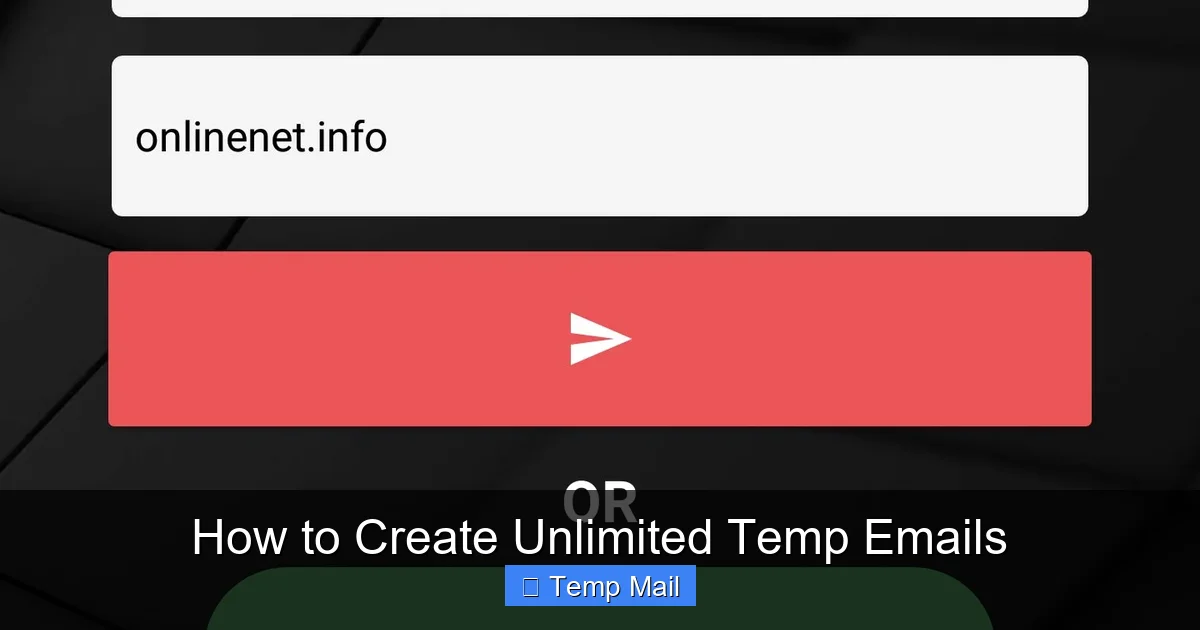
Visual guide about How to Create Unlimited Temp Emails
Image source: image.winudf.com
For Software Testers and Developers
Imagine you’re building an app that requires email verification. You need to test the sign-up flow, the password reset, the notification system. Using your real email for this is messy—you’ll get dozens of test emails. Using the same temp email for all tests can poison the data; if one test fails, the inbox might be clogged. You need a clean, unique inbox for every single test case. That’s dozens, even hundreds, of temp emails for a single project.
For Privacy-Conscious Users and Journalists
Every online account is a potential data leak point. If you use your main Gmail for a loyalty card at a grocery store, that’s one more entity with your primary contact. The principle of “least privilege” applies: give each service only the minimum contact info needed. A unique temp email for each newsletter, forum, or e-commerce site means that if that company gets hacked or sells your data, you can simply abandon that specific address. The spam or breach is isolated to a dead inbox. To do this comprehensively, you need many addresses.
For Accessing Regional or Gated Content
Some websites block certain countries or require an email from a specific domain (like a university .edu) to access content. By generating many temp emails, you can attempt to circumvent these basic blocks for research purposes, testing how a site responds to different regions, or accessing publicly available information that is unnecessarily gated.
For One-Time Use and Trials
Want to try a 7-day SaaS trial without the follow-up sales calls? Use a temp email. Want to download a whitepaper without joining a mailing list? Use a temp email. If you do this regularly for research or competitive analysis, you’ll burn through temp emails quickly. Having an unlimited supply means you never have to reuse an address, maintaining perfect isolation.
The Methodology: How to Actually Generate Unlimited Temp Emails
This is the heart of it. There is no single “unlimited temp email generator” button. You achieve volume through a combination of techniques. Think of it as a layered defense and supply strategy.
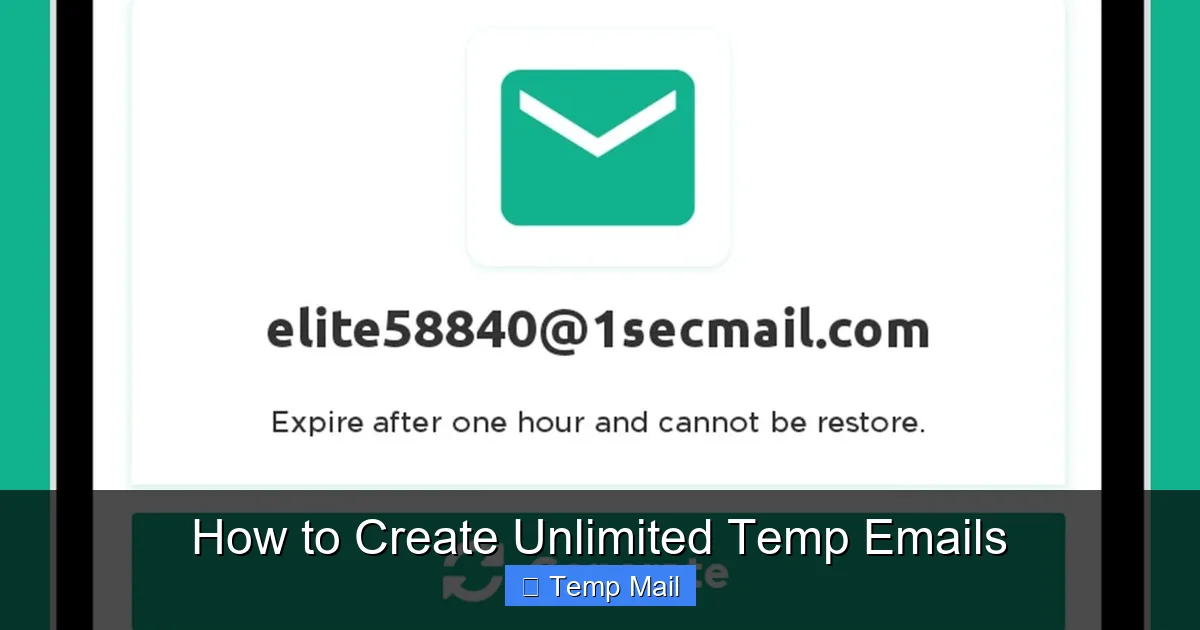
Visual guide about How to Create Unlimited Temp Emails
Image source: image.winudf.com
1. Master Browser Isolation and Session Management
This is your most powerful and fundamental tool. Temp email sites use cookies and browser fingerprinting to limit how many addresses you can generate from a single browser instance. If you just keep refreshing the same site in one Chrome window, it will eventually say “Too many requests” or give you the same address repeatedly. To bypass this, you must make each request look like it’s coming from a completely new, first-time visitor.
- Use Private/Incognito Windows: This is the simplest step. Each incognito window starts with a clean slate—no cookies, no cache. Open a new incognito window, go to the temp mail site, get an address, use it. Close the window. That session is dead. Open a new one. You can do this repeatedly. Most services allow 5-10 addresses per IP per day from fresh sessions before slowing down.
- Use Different Browsers: Firefox, Chrome, Safari, Brave, Edge. Each is a different fingerprint. Rotate between them. Use one browser for your first 10 addresses, switch to another for the next 10.
- Use Browser Profiles: This is more advanced but highly effective. In Chrome or Firefox, you can create multiple, separate “profiles.” Each profile has its own set of extensions, cookies, and cache. Create a profile called “TempMail-1,” use it until it’s rate-limited, then switch to “TempMail-2.” You can create dozens of profiles.
- Consider Virtual Machines or Containers: For the ultimate in isolation, spin up a lightweight virtual machine (using VirtualBox or VMware) or a browser container (like Firefox Multi-Account Containers). Each VM or container acts like a completely separate computer with its own IP (if configured with a VPN). This is the gold standard for avoiding any cross-contamination.
2. Leverage Domain Variation and Aggregator Sites
Not all temp mail services are the same. Some are single-domain (like 10minutemail.com). Others are aggregators that pull from multiple backend domains.
- Find Aggregator Lists: Search for “temp mail sites list” or “disposable email domains.” You’ll find articles and GitHub repos listing dozens of active services (e.g., tempmailo.com, dropmail.me, guerrillamail.info, getnada.com). Bookmark 20-30 of these.
- Rotate Between Services: Don’t just use one site. Use Site A until it limits you, then immediately switch to Site B. Since they are different companies with different rate limits and domains, you multiply your total output. Using 20 different services, each giving you 5 emails per day via isolation, theoretically gets you 100 emails daily.
- Understand Domain Pools: Some services (like Mail.tm or Temp-Mail.org) offer multiple domain options (@mail.tm, @temp-mail.org, @tmpmail.org). If a service allows you to choose your domain, use them all. Each domain is often treated as a separate pool of addresses.
3. Utilize Services with Custom Domains and APIs
This is the pro level. Some modern temp mail services offer features that make “unlimited” much more achievable and manageable.
- Custom Domain Forwarding Services: Services like SimpleLogin (now part of Proton) or AnonAddy are not classic “temp mail.” They are email alias services. You create a random alias like [email protected] that forwards to your real inbox. You can delete the alias anytime. The “unlimited” part comes from the fact that you can generate thousands of these aliases programmatically via their API. The emails go to your real inbox, but the sender only sees the disposable alias. You maintain control and can kill any alias that starts spamming you. This is arguably the most powerful and organized method for a “pseudo-unlimited” system.
- API-First Temp Mail Services: Some disposable email providers (like MailSlurp, Temp-Mail.io) offer robust APIs. You can write a simple script (in Python, JavaScript, etc.) that calls their API, generates a new inbox address, uses it for your sign-up, and then either checks the inbox via API or discards it. By using an API, you bypass website rate limits and can automate generation at scale, limited only by your paid plan (many have free tiers with hundreds of emails/month) and the service’s overall limits.
4. The “Wild West” Method: Self-Hosted Solutions
For the technically inclined, the ultimate in control and volume is running your own. This requires a server (a cheap VPS from DigitalOcean, Linode, etc.) and some Linux command-line knowledge.
- Mail Server Scripts: There are open-source projects on GitHub that implement a basic, temporary mail server (using Postfix, Dovecot, and a web interface like RainLoop or a custom script). You configure it to delete emails after 1 hour. You then point a domain you own (or a subdomain) to this server. You can write a script that generates random addresses at [email protected] and checks the maildir. Since you control the server, you are only limited by your server’s resources. This is truly unlimited, but it’s complex to set up, maintain, and secure. It also risks your server IP being blacklisted if used improperly.
Putting It All Together: A Practical Routine
A realistic, high-volume user’s workflow might look like this:
- Open a fresh Firefox profile (or a new VM).
- Navigate to your first aggregator site (e.g., tempmailo.com). Get address #1. Use it.
- When that site gives a “limit reached” message, close the browser.
- Open a new Chrome incognito window.
- Go to your second aggregator site (e.g., getnada.com). Get address #2.
- Repeat, cycling through your list of 30 sites and alternating between Firefox profiles, Chrome incognito, and Edge.
- For critical accounts you need long-term access to (like a 7-day trial you’re actually using), use an alias service like SimpleLogin to create a dedicated, manageable disposable address that forwards to you.
- At the end of the day, you could easily have 50-100+ unique, used temp email addresses.
Tools and Services: Your Unlimited Temp Email Toolkit
Let’s get specific. Here are the best-in-class tools for each method.
For Browser Isolation & Management
- Firefox Multi-Account Containers: A free, official Firefox extension. It lets you open sites in color-coded, isolated tabs. Containers separate storage, so Container A’s cookies for TempMailSite1 won’t affect Container B’s session on the same site. Perfect for rotating 10+ sessions simultaneously.
- Chrome Profiles: Built-in. Go to Settings > You and Google > Manage other people > Add person. Create as many as you want.
- VirtualBox: Free, powerful virtualization software. Create a base VM, snapshot it, and then clone it for each new “computer” you need. Install a browser in each. You can even assign different VPNs to different VMs for IP rotation.
For Aggregator and Standalone Temp Mail Sites
- Mail.tm: Excellent modern interface, multiple domains, no CAPTCHA often, relatively generous limits. A top-tier choice.
- Temp-Mail.org: Very popular, reliable, offers domain selection.
- Guerrilla Mail: A classic. Offers a 60-minute inbox, domain choices, and a simple interface.
- 10MinuteMail.com: The original. Simple, fast, 10-minute timer.
- DropMail.me: Allows you to “extend” the inbox time and has a clean design.
- Important: Always have a list of 20-30 sites. Sites go down, get blocked, or change policies. If your #1 site stops working, you have immediate backups.
For API & Alias Services (The “Smart Unlimited” Approach)
- SimpleLogin (by Proton): The gold standard. Free tier: 10 aliases/month. Paid plans offer unlimited aliases. You get a custom domain (e.g., @aleeas.com) or use your own. API is excellent. Emails forward to your real inbox, and you can reply from the alias. This is not a temporary inbox—it’s a permanent alias you can delete at any time. It’s the most professional solution for managing hundreds of disposable contacts.
- AnonAddy: Very similar to SimpleLogin. Open-source, self-hostable option available. Also offers a generous free tier and paid plans for more aliases.
- MailSlurp: Specifically designed for developers and testing. Provides real, programmable SMTP/IMAP inboxes via API. Free tier: 100 emails/month. Paid plans scale to thousands. You get actual inboxes you can programmatically create, send to, and read from. This is for serious automation.
- Temp-Mail.io API: Another API-focused disposable email service.
Risks, Limitations, and Ethical Boundaries
You can’t talk about creating unlimited temp emails without talking about the guardrails. Ignoring these can get your IP banned, your projects blocked, or worse.
Rate Limiting and IP Bans
Every service has limits. They are enforced by IP address. If you generate 100 emails from your home IP in an hour across 20 different sites, you might trigger anti-abuse systems. Your IP could be temporarily or permanently banned from that service. Solution: Use a reputable VPN (like Mullvad, ProtonVPN) to rotate your IP address periodically. Do not use free VPNs; they share IPs with spammers and are often already banned. Combine VPN rotation with your browser isolation for maximum effect.
Service Detection and Blocking
Many major platforms (Google, Facebook, Twitter, Netflix, most banking sites) maintain real-time lists of known temp mail domains. If you try to sign up with @mail.tm, they will reject it outright. This is their right. Solution: You cannot use classic disposable emails for essential accounts. For these, you must use a real email or a high-quality alias service (like SimpleLogin) that uses its own reputable domains, which are less likely to be on these blocklists.
Legal and Terms of Service Violations
Using temp emails to create multiple accounts to circumvent a ban (e.g., on a social media platform or game), to commit fraud, or to hide illegal activity is a violation of Terms of Service and can be illegal. The “unlimited” part does not make you immune from consequences if you abuse the system. Ethical Rule: Use temp emails for privacy protection and testing, not for deception, harassment, or bypassing legitimate restrictions.
Loss of Access and Data
By definition, temp emails are temporary. If you need to reset a password for an account you created with a temp email 3 months ago, you are locked out. The inbox is gone. Solution: Maintain a secure, encrypted password manager (like Bitwarden or KeePassXC). In the notes field for a site where you used a temp email, paste that temp email address. This way, if you ever need to reference it or recover an account (if recovery is email-based and you still have access to the temp inbox within its lifespan), you have the address recorded. For alias services, you always have the alias record in your dashboard.
Best Practices for Sustainable “Unlimited” Use
To make this work long-term without burning through services or getting frustrated, adopt these habits.
Create a Master Tracking System
Even with “unlimited” addresses, you need to know which address was used for what. Create a simple spreadsheet or, better, use your password manager. For each entry, include:
- Website/Service Name
- Date of Sign-up
- Full Temp Email Address Used
- Expected Expiration Date (if known)
- Purpose/Notes
This prevents you from accidentally reusing an address on a site where it’s already registered, and it helps you identify the source of any spam that might slip into a longer-lived alias.
Implement a Rotation Schedule
Don’t just hammer one service until it breaks. Have a planned rotation:
- Service Group A: Use on Monday, Wednesday, Friday.
- Service Group B: Use on Tuesday, Thursday.
- Service Group C: Use on weekends.
This spreads the load and respects implicit rate limits. Combine this with your browser/VM isolation schedule.
Know When to Use What Tool
- For one-time sign-ups you’ll never need again: Use a classic disposable inbox from an aggregator site (Mail.tm, etc.).
- For services you might use for a few weeks (trials, short projects): Use a SimpleLogin/AnonAddy alias. You control its lifespan.
- For automated software testing: Use an API service like MailSlurp. Integrate it into your test scripts.
- For maximum anonymity on a sensitive task: Use a fresh VM, a VPN, and a brand-new aggregator site you’ve never visited before.
Respect the Ecosystem
These free services exist because a small percentage of users need them for legitimate purposes. If everyone tries to generate 1000 emails a day, the services will collapse or start charging. Use what you need. Don’t be greedy. Your goal is sufficient privacy, not to break the system.
Conclusion: Empowerment Through Control
Creating unlimited temp emails isn’t about a single trick; it’s about adopting a system. It’s the disciplined application of browser isolation, service diversification, and smart tool selection. By understanding that “unlimited” is a function of strategy rather than a single product feature, you take control of your digital footprint. You stop feeding the spam machine with your primary, precious email address. You gain the freedom to explore, test, and access the web without leaving a permanent trail back to your core identity. Start simple: master incognito mode and bookmark five aggregator sites. As your needs grow, graduate to browser profiles and alias services. Always operate within ethical and legal boundaries, and maintain your own records. This is how you build a sustainable, personal pipeline of disposable email addresses that serves your needs for privacy, testing, and access, today and far into the future. Your inbox will thank you.
Frequently Asked Questions
Is it legal to create unlimited temporary email addresses?
Yes, creating and using disposable email addresses is legal. The legality depends on how you use them. Using them for privacy, testing, or to avoid spam is perfectly acceptable. Using them to commit fraud, evade bans, or harass others violates Terms of Service and can be illegal.
Will I get banned from websites for using a temp email?
You will likely be blocked from sign-up on major platforms like Google, Facebook, or Netflix, as they blacklist known temp mail domains. For smaller sites, forums, or content downloads, it often works. Using an alias service (like SimpleLogin) with a reputable domain reduces this risk significantly.
What’s the easiest way for a beginner to get multiple temp emails?
The simplest method is to open a new incognito/private browsing window for each new email you need. Then, visit a reliable aggregator site like Mail.tm or Temp-Mail.org. Each new incognito session will generate a fresh address. Cycle through 3-4 different aggregator sites to multiply your total.
Can I automate generating and checking these temp emails?
Yes, but you must use the right tools. Do not try to script clicks on a public temp mail website—you’ll be blocked instantly. Instead, use a service that offers an API, like MailSlurp or the API from SimpleLogin. These are designed for programmatic access and will allow you to generate and manage hundreds of addresses via code.
Are my activities with a temp email truly anonymous?
No, not truly anonymous. While your real email is hidden from the recipient, your activity is still tied to your IP address and device fingerprint. If you use a temp email for illegal activity, authorities can still trace it back to you through your IP. For privacy from marketing spam, it’s excellent. For evading law enforcement, it is not effective.
How do I remember which temp email I used for which site?
You must keep a record. The easiest way is to use a password manager (like Bitwarden, 1Password, or KeePass). When you sign up for a site with a temp email, save the site’s login entry in your password manager and include the temp email address in the “notes” or “username” field. For a simpler method, use a spreadsheet with columns for Website, Email Used, and Date.
Leave a Reply