Disposable email services provide temporary email addresses that expire after a short time. They are a powerful tool for protecting your primary email from spam, phishing, and data harvesting. By using a disposable email for online sign-ups and untrusted sites, you can keep your personal information private and maintain a clean inbox. Remember: never use disposable email for critical accounts like banking or primary communications.
Have you ever signed up for an online service, only to find your inbox flooded with spam a few days later? Or maybe you’ve hesitated to provide your email address on a sketchy website, fearing it might be sold to marketers or hackers. If so, you’re not alone. In today’s digital world, our email addresses are like keys to our online identity – and they’re constantly under attack. That’s where disposable email comes in. Think of it as a burner phone for your inbox: a temporary, throwaway address that you can use when you don’t want to reveal your real email. It’s a simple yet powerful tool for taking back control of your privacy.
Disposable email services, also known as temp mail or temporary email, provide you with an email address that exists for a short period – usually 10 minutes to a few hours – and then automatically deletes itself. You don’t need to create an account; you just visit a website, get a random address, and start receiving emails. When you’re done, you close the tab and the address vanishes. No strings attached. It’s like having a secret identity for the internet, one that shields your primary inbox from the mess of spam, phishing attempts, and data harvesting. In this guide, we’ll explore how disposable email works, why it’s essential for privacy protection, and how you can use it wisely in your daily online activities.
Key Takeaways
- Disposable emails are temporary addresses that protect your primary email from spam and data collection.
- They help you avoid unwanted marketing emails and phishing attempts.
- Using a disposable email reduces the risk of your personal information being exposed in a data breach.
- Ideal for signing up on websites with questionable privacy practices or for one-time use.
- Most disposable email services are free and require no registration.
- However, they are not suitable for important accounts like banking, work, or primary communications.
- Always choose a reputable disposable email provider to ensure reliability and security.
📑 Table of Contents
What is a Disposable Email?
A disposable email is a temporary email address that you can use for a short period without any long-term commitment. Unlike your personal or work email, which you maintain indefinitely, a disposable email is designed to be discarded after a single use or a brief timeframe. These addresses are generated by specialized websites or apps that don’t require you to sign up or provide any personal information. You simply visit the site, receive a random email address, and start using it. The inbox is usually accessible directly from the browser, and all messages are automatically deleted after a set time – often 10 minutes, 1 hour, or 1 day.
How Does It Work?
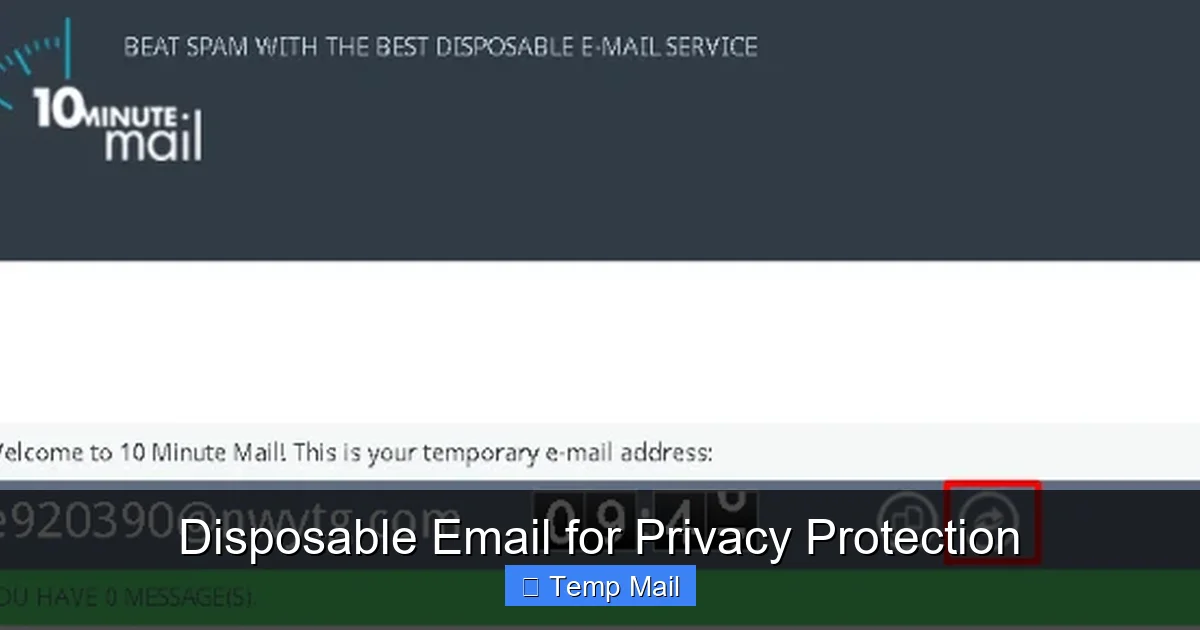
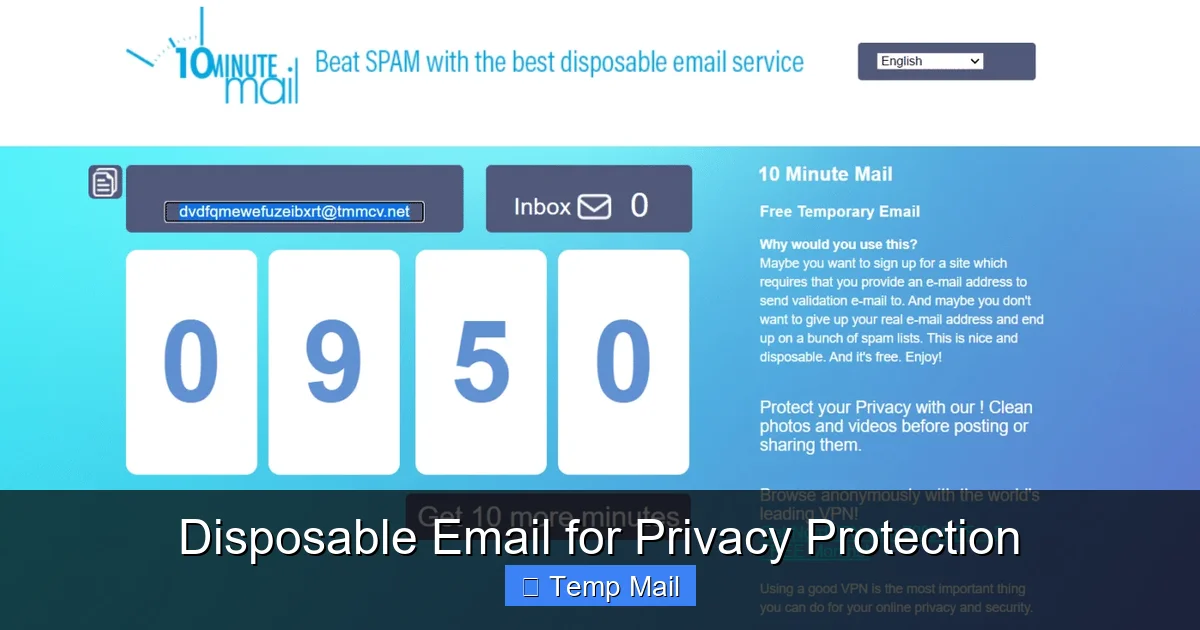
The technology behind disposable email is straightforward. When you visit a service like Temp-Mail or 10MinuteMail, the server creates a random email address associated with a temporary inbox. This inbox exists on the provider’s server and is not linked to your identity. You can then use that address to register on websites, download files, or receive verification codes. Any emails sent to that address appear in the temporary inbox, which you can view in real time. Once the timer expires, the inbox and all its contents are permanently erased. Some services also allow you to extend the time or manually delete the inbox earlier.
Types of Disposable Email Services
There are two main categories of disposable email services:
- Web-based platforms: These are websites you visit to get a temporary address. Examples include Temp-Mail.org, 10MinuteMail.com, and Guerrilla Mail. They are easy to use and require no installation.
- Browser extensions and mobile apps: Some services offer browser add-ons or smartphone apps that integrate directly with your browsing experience. For instance, the “Temp Mail” extension for Chrome generates a disposable address with one click and automatically fills it into web forms. These options provide added convenience.
Additionally, some email providers like Gmail offer “plus addressing” (e.g., [email protected]) which is not fully disposable but can be used to filter emails. However, true disposable email is completely anonymous and short-lived.
Lifespan and Inbox Management
The lifespan of a disposable email varies by provider. Common time limits are 10 minutes, 1 hour, 1 day, or until you close the browser tab. Some services let you extend the time by clicking a refresh button. The inbox typically shows the number of messages received, and you can read them by clicking. There’s no need for a password because the inbox is tied to the unique URL or session. Once the time is up, the address is recycled and may be given to another user. Therefore, you should never rely on a disposable email for important communications – if you need to retrieve a password later, it will be gone.
History and Evolution
Disposable email services emerged in the early 2000s as a response to the growing spam problem. The first known service, called “Mailinator”, launched in 2004 and popularized the concept of public, temporary inboxes. Since then, numerous providers have appeared, offering improved features like encryption, custom domains, and longer lifespans. Today, disposable email is an essential tool for privacy-conscious users worldwide.
The Privacy Threats in the Digital Age
Before we dive deeper into how disposable email helps, it’s crucial to understand why we need it. Our digital lives are under constant surveillance. Every time you enter your email address on a website, you’re potentially handing over a piece of your identity. That email can be used to track your online behavior, build a profile about you, and bombard you with targeted ads. Worse, it can become a target for hackers. Let’s examine the main privacy threats that make disposable email a necessity.
Visual guide about Disposable Email for Privacy Protection
Image source: mashtips.com
Data Collection and Profiling
Companies collect email addresses as a primary way to identify users. When you sign up for a free service, your email is often linked to your activity, purchases, and even your location. This data is then sold to advertisers or used to create detailed consumer profiles. For example, a shopping website might track what products you view and then send you personalized emails to lure you back. Over time, your email becomes a hub for profiling, and it’s hard to escape because changing your email doesn’t erase the data already collected. Disposable email breaks this chain by providing a different address each time, making it difficult for companies to stitch together your activities.
Spam and Phishing Attacks
Spam is more than just annoying; it’s a security risk. Once your email is leaked or sold, spammers flood your inbox with unsolicited messages. Some of these are phishing attempts designed to trick you into revealing passwords or credit card details. Phishing emails often mimic legitimate companies and may include urgent language like “Your account has been compromised.” By using a disposable email for non-essential sign-ups, you contain the spam to a temporary inbox that self-destructs, keeping your primary email clean and reducing exposure to phishing.
Data Breaches and Credential Stuffing
Data breaches are alarmingly common. When a website you signed up with gets hacked, attackers often steal email addresses and passwords. If you used your primary email, that address now floats around the dark web, making you a target for credential stuffing attacks (where hackers try the same password on multiple sites). With a disposable email, even if the site is breached, the compromised address is temporary and not linked to your other accounts. This limits the damage and protects your main identity.
Identity Theft and Account Takeover
When your email is compromised, attackers can use it to reset passwords on other accounts, leading to identity theft. Disposable email reduces this risk by ensuring that your primary email is never exposed in the first place.
How Disposable Emails Protect Your Privacy
Now that we’ve seen the threats, let’s explore how disposable email acts as a shield. It’s not just about avoiding spam; it’s about reclaiming control over your personal information. Here’s how temporary email addresses safeguard your privacy in practical ways.
Visual guide about Disposable Email for Privacy Protection
Image source: optery.com
Shielding Your Primary Email Address
Your primary email is the cornerstone of your online identity. It’s used for password resets, important notifications, and often as a login for critical services. By using a disposable email for anything that isn’t essential, you keep your primary address hidden from marketers, data brokers, and hackers. This means fewer spam emails, lower risk of phishing, and less chance that a breach will expose your main account. Think of it as a firewall: the disposable address absorbs the junk so your real inbox stays pristine.
Avoiding Unwanted Tracking and Cookies
Many websites use your email as a unique identifier to track you across the web. Even if you clear cookies, they can recognize you through your email address. Disposable email disrupts this tracking because each site gets a different address. Without a consistent identifier, it’s much harder for advertisers to build a longitudinal profile of your behavior. This enhances your anonymity and reduces the creepiness factor of targeted ads that seem to follow you everywhere.
Reducing Your Digital Footprint
Every online account you create leaves a digital footprint. Over years, this footprint grows庞大 and can be used to reconstruct your identity. Disposable email lets you create “ephemeral” accounts that disappear. For instance, if you sign up for a one-time discount using a disposable email, that account vanishes after a few hours, leaving no trace. This practice minimizes the amount of personal data stored on servers you don’t trust, effectively shrinking your digital footprint and making it harder for anyone to piece together your online history.
Preventing Email Tracking
Some senders use invisible pixels or tracking links to see if you opened an email and where you clicked. With a disposable email, you’re less likely to open such emails because they’re in a temporary inbox that you might not check regularly. Even if you do, the tracking data is tied to a throwaway address, not your real identity.
Top Use Cases for Disposable Emails
Disposable email isn’t just for tech-savvy privacy nuts; it’s a practical tool for everyday internet users. Here are some common scenarios where a temporary email address can save you from headaches.
Visual guide about Disposable Email for Privacy Protection
Image source: icpmedical.com
Online Shopping and Discounts
Who doesn’t love a good discount? But many retailers ask for your email to send a coupon code. If you use your primary email, you’ll likely be added to their promotional list, and your inbox will never be the same. Instead, use a disposable email to grab the code, make your purchase, and then forget about it. The retailer gets their required email, but you avoid the long-term spam. This is especially useful for one-time purchases from unfamiliar stores.
Social Media and Forum Registrations
Signing up for a new social media platform or online forum? Some of these sites have questionable privacy policies or may sell your data to third parties. Using a disposable email for initial sign-up protects your main address. However, note that for social media you intend to use regularly, you might want a more permanent solution because you’ll need to receive notifications. But for throwaway accounts or testing a new service, disposable email is perfect.
Downloading Gated Content
Many blogs and companies offer free e-books, whitepapers, or software trials in exchange for your email address. This is a classic lead generation tactic. While the content might be valuable, you’re essentially trading your email for it. If you’re not interested in future communications from that company, use a disposable email. You’ll get the download link without cluttering your primary inbox.
Software Trials and Beta Testing
Want to try a new app or software without commitment? Most trials require an email to send a download link or activation code. Use a disposable email so that the company can’t follow up with marketing emails after the trial ends. This also applies to beta testing programs where you might sign up for early access. Keep your primary email free for software you actually plan to buy.
One-Time Communications
There are many situations where you need to share an email address but don’t want a long-term connection. Examples include posting a Craigslist ad, applying for a short-term gig, or contacting a service provider for a quote. A disposable email gives you a temporary point of contact that disappears after a few days, protecting your personal information from strangers.
Testing and Development
Developers and testers often use disposable emails to create multiple accounts for testing purposes. This avoids using real user data and prevents test accounts from interfering with production systems. It’s a common practice in QA workflows.
Accessing Public Wi-Fi
Many airports, cafes, and hotels require an email address to sign up for Wi-Fi access. Using a disposable email prevents these venues from adding you to their marketing lists or sharing your data with advertisers.
Online Gaming
Some online games or gaming platforms ask for an email to create an account. If you’re trying a new game and aren’t sure if you’ll stick with it, a disposable email avoids cluttering your main inbox with game updates and promotions.
Choosing a Reliable Disposable Email Service
Not all disposable email services are created equal. Some may have hidden agendas, poor security, or unreliable uptime. Here’s what to look for when selecting a provider.
Key Features to Look For
When evaluating a disposable email service, consider these factors:
- Inbox duration: How long does the email address last? Choose based on your needs – 10 minutes for quick verifications, 1 hour or more for longer interactions.
- Domain variety: Some services offer multiple domain names ([email protected], @dispostable.com). This can be useful if a particular domain is blocked by a website.
- Security: Look for services that use HTTPS encryption to protect your temporary inbox from eavesdropping. Avoid sites that don’t have a padlock icon in the address bar.
- No registration required: The best disposable email services don’t ask you to sign up. If they do, they’re not truly disposable.
- Ad-free experience: Many free disposable email sites display ads. While not a deal-breaker, excessive ads can be annoying and sometimes malicious. Choose a provider with a clean interface.
- Ease of use: The inbox should load quickly and be straightforward to navigate. Some services offer browser extensions for one-click generation.
Popular Disposable Email Providers
Here are some well-known disposable email services that have stood the test of time:
- Temp-Mail: One of the most popular, offering a random address, multiple domains, and an option to manually choose an address. It also has a mobile app and browser extension.
- 10MinuteMail: As the name suggests, it provides a 10-minute email address. Simple, no-frills, and reliable.
- Guerrilla Mail: Offers a disposable address with a 1-hour lifespan and the ability to send emails (not just receive). It also allows you to choose a username.
- Mailinator: A public inbox service where any address @mailinator.com can be accessed by anyone without a password. Not recommended for sensitive info but useful for quick verifications.
- DropMail: Provides a custom disposable address that you can extend. It also offers a Chrome extension.
Always check the current reputation of these services, as their policies may change.
Tips for Safe Usage
To get the most out of disposable email while staying safe, follow these tips:
- Never use disposable email for critical accounts: This includes banking, primary email, social media you care about, or any service where you need to recover a password. If the disposable address expires, you’ll lose access.
- Avoid sending sensitive information: Temporary inboxes may not be as secure as your primary email. Don’t use them to transmit passwords, financial data, or personal documents.
- Check the provider’s privacy policy: Ensure they don’t log your IP address or sell your data. Reputable services delete messages immediately after the timer ends.
- Use a different disposable address for each site: This maximizes anonymity and helps you track which sites might be spamming you.
- Be aware of blacklisting: Some websites block known disposable email domains. If you encounter this, try a different provider or domain.
Self-Hosted Disposable Email Solutions
For tech-savvy users, there are open-source solutions that allow you to run your own disposable email server. This gives you full control over data retention and security, but requires technical expertise to set up and maintain. Projects like “Mail.tm” or “SimpleLogin” (which offers aliasing rather than pure disposable) can be self-hosted for those who want complete privacy.
Limitations and Risks of Disposable Emails
While disposable email is a powerful privacy tool, it’s not a silver bullet. Understanding its limitations helps you use it responsibly and avoid pitfalls.
Not for Important Accounts or Services
The most critical limitation is that disposable email is, by design, temporary. If you use it to sign up for a service where you need long-term access – like online banking, cloud storage, or your main email – you’ll be locked out as soon as the address expires. Password reset links will go to an inbox that no longer exists. Therefore, reserve disposable email for low-stakes, non-essential activities only.
Potential for Abuse and Blacklisting
Because disposable email addresses are anonymous and easy to create, they are often abused by spammers and fraudsters. As a result, many websites and online services block entire domains associated with disposable email providers. If you try to sign up with a blocked domain, you’ll get an error message. This can be frustrating, but it’s a trade-off for privacy. To work around it, you can switch to a different provider or use a less common domain. However, if a site is particularly strict, you may have no choice but to use your real email.
Legal and Compliance Considerations
In some jurisdictions, using a disposable email to create an account may violate terms of service or even laws if it’s done to conceal identity for fraudulent purposes. While using temp mail for privacy is generally legal, it’s important to read the terms of the website you’re signing up for. Some sites explicitly prohibit disposable email addresses. If you violate their terms, they could suspend your account. Additionally, for services that require identity verification (e.g., financial institutions), disposable email will not be accepted because they need a stable contact method.
Limited Functionality
Disposable email services typically only support receiving emails; sending is often restricted or disabled. Even when sending is allowed (like in Guerrilla Mail), it’s usually limited to the same temporary address. So you can’t use it as a full-fledged email client. Also, attachments may be blocked or size-limited. For most verification purposes, receiving is enough, but if you need to send emails regularly, you’ll need a permanent solution.
Ethical Considerations
While using disposable email is a legitimate privacy practice, it can be misused for malicious purposes like creating fake accounts for trolling or fraud. Responsible use means employing temporary emails only for legitimate privacy protection, not to evade accountability for harmful actions.
Conclusion
Disposable email is a simple yet effective tool for protecting your online privacy. By using temporary email addresses for non-essential sign-ups, you can keep your primary inbox free from spam, reduce your exposure to data breaches, and limit the amount of personal information collected by companies. It’s like having a privacy shield that you can deploy whenever you’re unsure about a website’s trustworthiness.
However, it’s important to use disposable email wisely. Never rely on it for critical accounts, and always choose a reputable provider to ensure your temporary messages are secure. Remember that while disposable email helps you avoid unwanted tracking, it’s just one piece of a broader privacy strategy. Combine it with other practices like using strong, unique passwords, enabling two-factor authentication, and being cautious about what you share online.
In a world where our data is constantly bought, sold, and exploited, taking small steps like using disposable email can make a big difference. So next time you’re asked for your email on a sketchy site, reach for a temporary address instead. Your future self (and your inbox) will thank you.
Frequently Asked Questions
Is using disposable email legal?
Yes, using disposable email for privacy protection is legal in most countries. However, it may violate the terms of service of some websites, and using it for fraudulent activities is illegal. Always use temporary email responsibly and for legitimate purposes.
Can disposable email be traced back to me?
Reputable disposable email services do not require personal information and do not log your IP address, making tracing extremely difficult. However, if you access the disposable inbox from a network that identifies you (like a work or school network), your IP might be logged by the service. For maximum anonymity, use a VPN and avoid logging in from identifiable networks.
How long do disposable emails last?
The lifespan varies by provider. Common durations are 10 minutes, 1 hour, 1 day, or until you close the browser tab. Some services allow you to extend the time manually. Always check the specific timer of the service you’re using.
Are disposable email services secure?
Security depends on the provider. Look for services that use HTTPS encryption and have a clear privacy policy stating that messages are deleted after expiration. Avoid providers that display excessive ads or ask for personal details. While no service is 100% foolproof, reputable disposable email platforms are generally safe for receiving non-sensitive information.
Why would a website block disposable email addresses?
Websites block disposable email domains to prevent spam, abuse, and fake account creation. Since disposable emails are anonymous and temporary, they are often used by bad actors to create accounts for malicious purposes. To maintain a legitimate user base, many sites restrict sign-ups from known disposable email domains.
Can I send emails from a disposable address?
Most disposable email services only allow receiving emails, not sending. A few, like Guerrilla Mail, permit sending limited emails from the temporary address. However, sending capabilities are usually restricted to the same temporary inbox and are not meant for regular communication. For sending emails, you need a permanent email account.
Leave a Reply